
VASP corporate documents are the records a firm collects before onboarding a virtual asset service provider (VASP). The firm may be a bank, payment firm or crypto platform. The VASP may be a customer, partner or counterparty. The documents show who owns and runs the business and whether it is licensed. They also show whether its AML/CFT controls are credible. So a complete, well-checked set of VASP corporate documents is the foundation of know-your-business (KYB) due diligence. That diligence continues after onboarding, through ongoing monitoring and periodic refresh.
This guide sets out a practical KYB checklist for VASP corporate documents. It also explains what to check in each document and which red flags to watch for. Finally, it covers how often to refresh the file. Because requirements vary by jurisdiction, firms should adapt the checklist to their own rules and risk appetite.
Key takeaways on VASP corporate documents
- KYB on a VASP starts with standard corporate documents. However, it must go further than for an ordinary company.
- Licensing or registration evidence is central. However, a licence does not prove that AML/CFT controls work.
- Firms should verify VASP corporate documents against independent sources, such as company and regulator registers, instead of just accepting copies.
- Beneficial ownership and control need particular care, because crypto groups often use layered structures across several jurisdictions.
- Finally, firms should refresh the file on a risk basis and after trigger events, not only at onboarding.
Why VASP corporate documents need extra scrutiny
Every business customer needs basic identification. For example, FATF’s 2019 best practices paper on beneficial ownership of legal persons describes core company information. This includes the company name, proof of incorporation, legal form and status, and registered office address. It also includes the constitutional documents that set out the company’s governing powers, and a list of directors. However, FATF sets standards for countries. So each firm’s actual document requirements come from local law and its own risk-based policies.
VASPs, however, raise extra questions. Their business models change quickly, many operate across borders, and licensing regimes differ widely. In addition, their exposure to virtual assets can create sanctions, fraud and other illicit finance risk, including proliferation financing. Ordinary corporate checks will not reveal that risk. So KYB on a VASP combines standard corporate documents with crypto-specific evidence.
KYB checklist: VASP corporate documents to collect
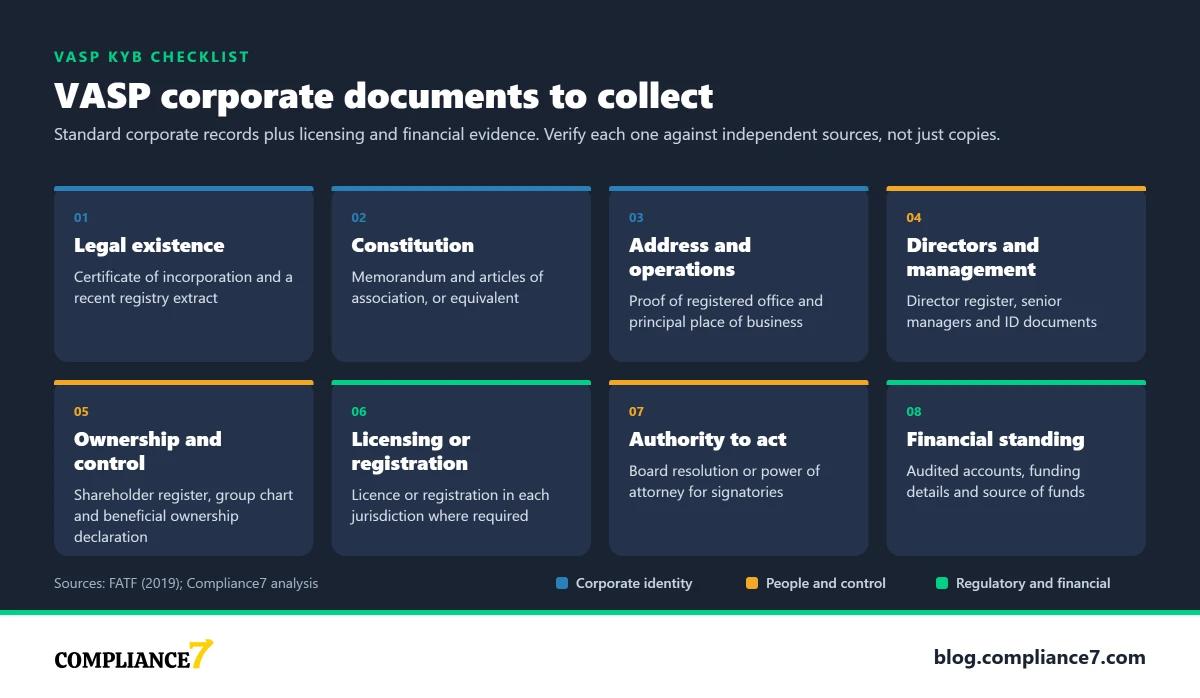
The table below groups the VASP corporate documents most firms request. In practice, firms should scale the depth of review to the VASP’s risk profile.
Corporate identity and management
| Area | Documents to collect | What to check |
|---|---|---|
| Legal existence | Certificate of incorporation or registration, recent company registry extract | Legal name, registration number, status and date of incorporation match the register |
| Constitution | Memorandum and articles of association, or equivalent constitutional documents | Business purpose, powers and any limits on who can bind the company |
| Address and operations | Proof of registered office and principal place of business | Whether the VASP has real operations where it claims. A thin physical presence is a risk indicator to assess, not an automatic adverse finding |
| Directors and management | Register of directors, list of senior managers, identity documents for directors, beneficial owners and authorised representatives | Identity, experience and any adverse media, sanctions or regulatory history |
Ownership, licensing and financial standing
| Area | Documents to collect | What to check |
|---|---|---|
| Ownership and control | Shareholder register, group structure chart, beneficial ownership declaration, and trust deeds or partnership agreements where relevant | Natural persons who ultimately own or exercise effective control over the VASP. Apply the ownership thresholds under local law, which vary by jurisdiction, together with control tests. If no one qualifies, use the local fallback rule, such as naming the senior managing official |
| Licensing or registration | Licence, registration certificate or regulator confirmation, where applicable, in each jurisdiction where the VASP must be licensed or registered | Status, permitted activities, territorial scope (including any passporting rights), conditions and any public enforcement action. Assess any claimed exemption rather than treating it as unlicensed |
| Authority to act | Board resolution or power of attorney for account signatories | Whether the firm has identified and authorised each signatory |
| Financial standing | Audited financial statements where available, or management accounts, funding details and source-of-funds evidence. For custodial VASPs, proof-of-reserves reports can add information on specified asset holdings, within their scope. SOC 2 reports can help assess technology and operational controls. Neither replaces a financial audit or an independent AML review | Financial standing, funding sources, consistency with the declared business and any going-concern doubts |
Crypto-specific documents for VASP KYB
Beyond standard corporate documents, firms should also ask for evidence of the VASP’s own AML/CFT/CPF framework. This covers money laundering, terrorist financing and proliferation financing. For example, typical requests include:
- AML/CFT policy summary: covering customer due diligence, sanctions screening, transaction monitoring and suspicious transaction reporting.
- Compliance officer details: the name and experience of the money laundering reporting officer or principal officer.
- Risk assessment summary: the VASP’s own assessment of its products, customers and jurisdictions.
- Independent audit evidence: a recent independent AML review or audit report, with the status of remediation actions, where available.
- Control implementation evidence: sample evidence that key controls work in practice. Requests should respect confidentiality, data protection and security limits.
- Regulatory history: any examinations, findings or enforcement actions.
- Travel Rule compliance: how the VASP collects, verifies, retains and securely transmits required originator and beneficiary information. It should also explain how it handles counterparty VASPs and missing data. Ask which messaging solutions and protocols it uses, whether they support data standards such as IVMS 101, and whether they work with your own systems.
- Blockchain analytics: which tools the VASP uses to screen wallets and monitor transactions.
- Product and customer profile: services offered, supported assets, customer types and countries served.
Further checks for higher-risk VASPs
For higher-risk VASPs, firms may also ask about group-wide controls, outsourced compliance work and custody of client assets. Banking links, unhosted wallet exposure and the independence of the compliance team can matter too.
Some financial institutions also use industry questionnaires, such as the Wolfsberg Group’s Correspondent Banking Due Diligence Questionnaire (CBDDQ). It includes questions on virtual asset activity. However, it is a correspondent banking tool, not a substitute for VASP-specific due diligence. So firms should add VASP-specific questions and verify the answers independently.
How to verify VASP corporate documents
Collecting VASP corporate documents is only the first step. After that, verification turns a file into evidence. In practice, firms should:
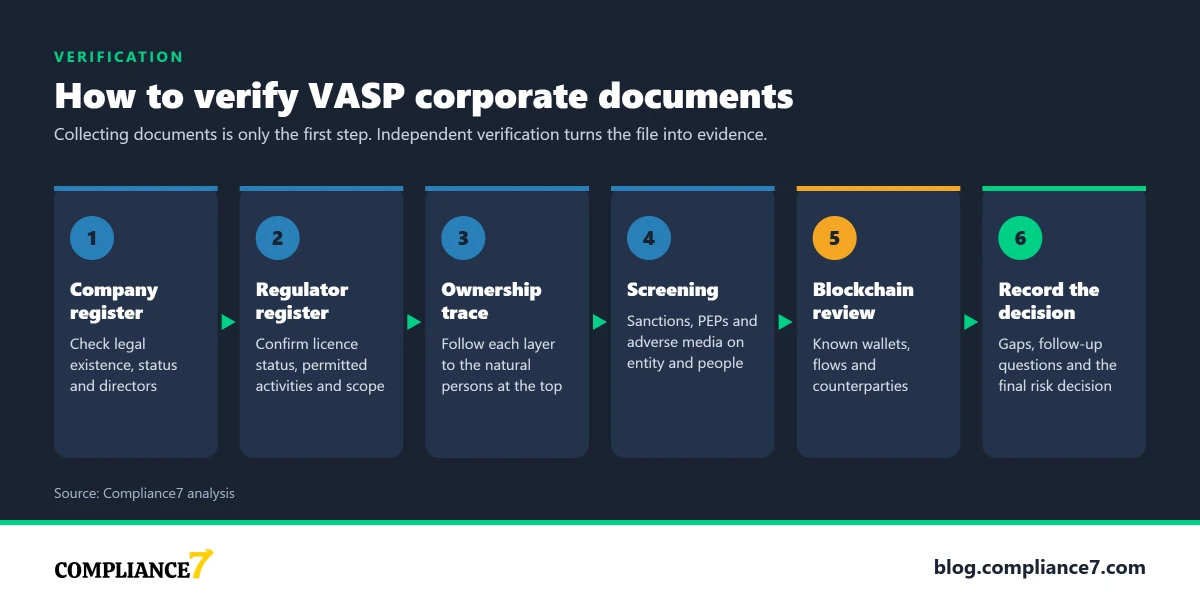
- check legal existence and directors against the official company register;
- confirm licence or registration status on the regulator’s public register, or directly with the regulator where needed;
- trace ownership through each layer of the group to the natural persons at the top;
- screen the entity, directors and beneficial owners for sanctions, politically exposed persons and adverse media;
- review blockchain data on the VASP’s known wallets, flows and counterparties, allowing for gaps in attribution; and
- record any gaps, the follow-up questions asked and the final risk decision.
Some documents may be in a foreign language or issued abroad. In that case, firms may need certified translations or apostilled copies. That depends on the country, the document and their own policy. Next, our guide to counterparty VASP due diligence explains how to turn this evidence into a risk decision.
Red flags in VASP corporate documents
Certain patterns should prompt enhanced due diligence or a decision not to proceed. For example:
- A licence that cannot be found on the regulator’s register, or that does not cover the services offered.
- Complex ownership chains through several jurisdictions with no clear business reason.
- Nominee directors or shareholders, or reluctance to name the beneficial owners.
- A registered address that is only a mail-forwarding service, with no evidence of real operations. However, virtual offices and registered agents are not improper in themselves.
- Recent changes of name, ownership or jurisdiction shortly before the onboarding request.
- Generic or copied AML policies that ignore virtual asset risks, such as unhosted wallets or Travel Rule workflows.
- Customer and company funds mixed together, especially where local law requires segregation or the VASP claims to safeguard client assets.
- Significant direct or indirect on-chain exposure to sanctioned entities, mixers or other higher-risk services.
However, no single red flag proves wrongdoing. Firms should assess each one in context and document their reasoning.
Refreshing VASP corporate documents
KYB is not a one-off exercise. Instead, firms should set a review frequency based on the VASP’s risk rating, and review higher-risk relationships more often. They should also refresh the file after trigger events. For instance, these include a change of ownership or directors, or a new or lost licence. Regulatory action, adverse media and unusual transaction activity are triggers too.
In addition, firms should track expiry dates on licences and identity documents. Otherwise, the file can quietly go out of date. For a broader view of due diligence levels, see our guide to KYC vs CDD vs EDD.
Conclusion: making VASP corporate documents work
Effective VASP KYB goes beyond collecting certificates and licences. Firms need to understand the VASP’s ownership, regulatory standing, business model and control environment. So independent verification, a risk-based assessment and ongoing monitoring all matter. Together, they help firms spot gaps and manage financial crime risk before and during the relationship.
Frequently asked questions
Which VASP corporate documents are needed for KYB?
Typically, firms ask for a certificate of incorporation, constitutional documents and a register of directors. They also request a shareholder register, group chart, licence or registration evidence and proof of address. In addition, they should request crypto-specific evidence, such as an AML/CFT policy summary and Travel Rule details.
Is a VASP licence enough to onboard a crypto business?
No. A licence or registration confirms regulatory status, but it does not prove that the VASP’s AML/CFT controls work. So firms should assess the controls, ownership and on-chain exposure separately.
How do you verify the beneficial owners of a VASP?
First, firms should trace ownership through each layer of the group to the natural persons at the top. They should also look for control through other means, such as voting agreements. Then they should verify those individuals’ identities. Finally, they should check the structure against registers and other independent sources where available.
How often should VASP KYB documents be refreshed?
It depends on the risk rating and local rules. For example, higher-risk VASPs need more frequent reviews. In any case, firms should refresh the file after trigger events, such as ownership changes or regulatory action.
Can a firm rely on a due diligence questionnaire alone?
No. Questionnaires help structure the review, but they rely on self-disclosure. Firms should test the answers against documents, registers and their own screening.
Need help reviewing a VASP’s corporate documents?
Compliance7 supports banks, payment firms and crypto platforms with VASP due diligence. That includes reviewing corporate documents, testing licensing and ownership evidence, and assessing AML/CFT controls before onboarding. Talk to our team about your next VASP onboarding or periodic review.
Related Compliance7 guides
- Core guide: Counterparty VASP Due Diligence: Assessing the VASP on the Other Side of a Transfer
- Related: KYC vs CDD vs EDD: Differences, Requirements and When Each Applies
- Related: Travel Rule Compliance Audit: How VASPs Can Prepare in 2026
- Related: FIU-IND Registration: Applicability, Process and Compliance Guide
This article is for informational purposes only and does not constitute legal or regulatory advice. Requirements vary by jurisdiction. For guidance specific to your business, consult a qualified compliance professional.