
Last reviewed: October 2026. Dates updated to reflect that Tranche 2 obligations commenced on 1 July 2026.
Australia’s Tranche 2 AML/CTF reforms took effect on 1 July 2026. Businesses across legal, accounting, real estate, conveyancing and precious-metal sectors that provide designated services now have AUSTRAC obligations. As a result, these firms must enrol or register with AUSTRAC, develop a compliant AML/CTF Program and appoint a governance structure that satisfies regulatory expectations. Because these obligations are detailed and time-sensitive, this guide walks you through every step — from understanding deadlines, AUSTRAC registration steps to building your compliance framework — while also highlighting how Compliance7 can support your transition efficiently and cost-effectively.
Why AUSTRAC Tranche 2 Compliance Matters
While many firms assume Tranche 2 obligations are merely procedural, the reality could be more serious. In recent years, AUSTRAC has significantly intensified enforcement and as a result, businesses that fail to comply often face heavy remediation costs, reputational harm and regulatory pressure. Furthermore, clients increasingly expect compliance maturity as a baseline requirement, meaning that firms risk losing business if they fall behind.
Therefore, businesses that are not yet fully compliant should act now. Putting the required processes in place quickly helps your organization meet its obligations, reduce enforcement risk and demonstrate trustworthiness to clients and stakeholders.
Who Needs to Comply?
Although Tranche 2 reforms apply to a wide range of professional service providers, the largest impacted groups include:
- Accounting firms and bookkeepers
- Law firms and legal practitioners
- Conveyancers and property settlement agents
- Real-estate agencies and property professionals
- Trust & company service providers (TCSPs)
- Dealers in precious metals or stones
- Virtual asset and remittance service providers
What activities does Tranche 2 cover?
Tranche 2 extends the AML/CTF Act to designated non-financial businesses and professions (DNFBPs). The activities below are typical examples of services that may bring a business into scope.
| Sector | Example activities |
|---|---|
| Legal | Handling client funds and trust accounts, property transactions |
| Accounting and advisory | Company formation, corporate structuring and related advisory work |
| Real estate | Buying, selling and settling property transactions |
| Trust and company service providers | Company formation, nominee services and registered office services |
| Dealers in precious metals and stones | High-value purchases and sales, particularly in cash |
Whether a particular service is a designated service depends on the wording of the AML/CTF Act and Rules. Businesses should confirm their position against current AUSTRAC guidance.
Why were the Tranche 2 reforms introduced?
Australia was one of only a few FATF members that did not apply AML/CTF obligations to most DNFBPs. FATF evaluations repeatedly identified this gap. Lawyers, accountants, real estate agents and company service providers can act as gatekeepers to the financial system. As a result, criminals may misuse them to move or disguise illicit funds. Tranche 2 is intended to close that gap and align Australia more closely with the FATF Recommendations.
Which sectors face the biggest adjustment?
Most newly regulated businesses have never run an AML/CTF program before. The adjustment is likely to be greatest for:
- Small and mid-sized law firms, which often lack dedicated compliance resources.
- Accounting and corporate advisory firms, because company formation and structuring work carries elevated risk.
- Real estate agencies, because high transaction values attract laundering attempts.
- Dealers in precious metals and stones, where cash purchases increase monitoring needs.
Because many of these businesses have never been regulated under AML/CTF laws before, transitioning into compliance may feel overwhelming. Therefore, understanding your obligations now will help you navigate the process smoothly.
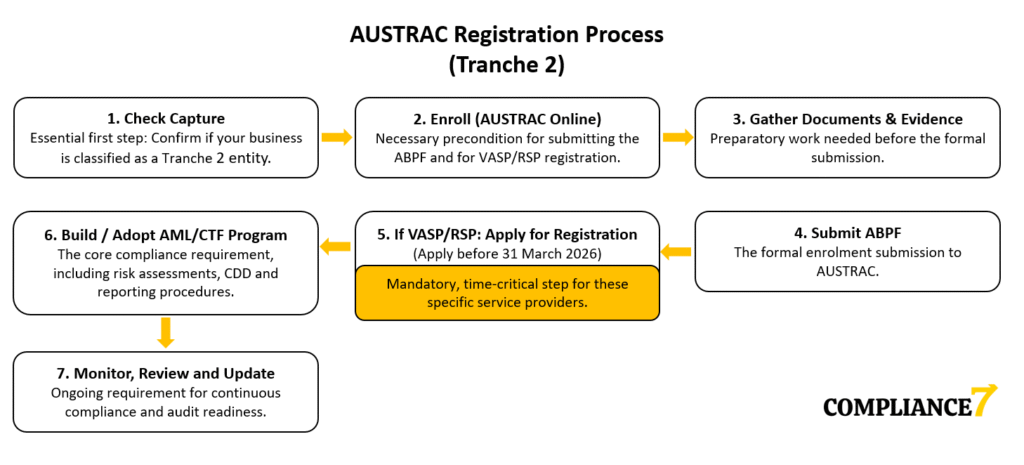
Step-by-Step: AUSTRAC Registration Steps for Tranche 2 Entities
To help you follow a structured and efficient path, the following step-by-step instructions incorporate all key deadlines, requirements and transition points.
Step 0 — Quick Readiness Checklist
Before logging into AUSTRAC Online, it is important to gather your business documentation. By doing so in advance, you minimize delays and avoid incomplete submissions.
Checklist items include:
- ABN/ACN, legal and trading names
- Beneficial ownership and corporate structure
- Name, Address, Phone
- Description of designated services
- Director and key personnel details
- Recent financial statements
- Police checks (required for RSP/VASP)
- Draft AML/CTF Program components
Since missing information is one of the most common causes of submission delays, we recommend preparing all documents in one secure folder.
1. Confirm Whether You Are a Regulated Tranche 2 Entity
To begin, determine whether your services fall under the newly regulated Tranche 2 categories. If your business provides designated services in Australia under these reforms, you must enroll with AUSTRAC. Moreover, if your organization operates as an RSP or VASP, you must register — not merely enroll.
This distinction is critical because registration involves additional checks and suitability assessments.
2. Understand the Key Deadlines
The main Tranche 2 commencement dates have now passed. The timeline below shows where each one stands as at October 2026:
- 31 March 2026 – The AML/CTF reforms commenced and enrolment for newly regulated businesses opened in AUSTRAC Online. Tranche 2 AML/CTF obligations themselves did not apply until 1 July 2026 (passed)
- 1 July 2026 – Tranche 2 obligations commenced (passed)
- 29 July 2026 – Enrolment deadline for businesses already providing designated services on 1 July 2026 (passed)
- Within 28 days – Ongoing rule: a business that starts providing a designated service after 1 July 2026 must enrol within 28 days of first providing it
- 30 June 2029 to 31 December 2030 – First independent evaluation due for businesses newly regulated from 1 July 2026. The exact date depends on the last two digits of the business’s AUSTRAC account number under the AML/CTF Transitional Rules 2026
If your business had to enrol by 29 July 2026 and has not done so, it should seek advice and contact AUSTRAC promptly.
3. Gather All Required Documents before Enrolling
Next, collect all documentation needed for the enrolment process. Doing this proactively ensures a smooth AUSTRAC Business Profile Form (ABPF) submission and reduces the risk of AUSTRAC requesting additional information later.
Required documents include:
- Legal identity and registration details
- Organizational chart or governance summary
- Beneficial ownership information
- Financial statements
- Foreign regulatory registrations (if any)
- Key personnel details
- Suitability assessments for RSP/VASP roles
- AML/CTF Program (draft or final)
Because AUSTRAC emphasizes transparency, your provided information must be accurate and complete.
4. Create AUSTRAC Online Account & Submit ABPF (Enrolment)
After gathering your documents, you can move on to creating an AUSTRAC Online account. Once logged in, complete the AUSTRAC Business Profile Form (ABPF). This form captures essential information about your business model, structure, personnel and designated services.
Additionally, you may save your progress temporarily while reviewing your data. Finally, submit your form and securely store the confirmation email, since it forms part of your compliance records.
5. Apply for Registration (If You Are an RSP or VASP)
If your business operates remittance or virtual asset services, you must register with AUSTRAC after enrolment. Because registration requires additional suitability checks, such as police certificates, you will need extra time to gather those documents.
Importantly, you cannot operate these services until AUSTRAC approves your registration. Consequently, applying early helps ensure you do not delay business operations.
6. Build Your AML/CTF Program (Mandatory)
Enrolment is only one stage; every Tranche 2 entity must also develop an AML/CTF Program. This program outlines how your business manages ML/TF risks through governance, policies and controls.
A complete AML/CTF Program includes:
- ML/TF risk assessment
- CDD & EDD procedures
- Governance structure
- Appointment of AML/CTF Compliance Officer
- Staff training
- Sanctions & PEP screening
- Transaction monitoring
- Suspicious Matter Reporting (SMR)
- Record keeping (7-year minimum)
- Independent evaluation (at least once every three years)
Because creating a program from scratch is time-consuming and complex, you can take support from firms like Compliance7 for templates and expert support.
7. Maintain & Update Your Compliance over Time
Finally, after enrolment and program development, your business must continually maintain, update and review its AML/CTF Program.
This includes:
- Updating AUSTRAC within 14 days for key changes
- Conducting ongoing staff training
- Reviewing CDD and EDD processes
- Documenting all monitoring and reporting activities
- Scheduling periodic internal and external reviews
Since compliance is an ongoing obligation, documenting every step helps demonstrate your commitment to AUSTRAC.
Why Partner With Compliance7?
Because Tranche 2 compliance introduces new and complex obligations, you can partner with Compliance7 for specialized support. Our team provides comprehensive solutions, ensuring that businesses transition smoothly into the new regulatory environment.
Compliance7’s Key Services Include:
- Outsourced & Fractional Compliance Officer – ideal for firms lacking internal resources
- AML/CTF Program Development – including risk assessments and governance frameworks
- CDD/EDD & KYC Program Setup – to ensure compliant onboarding
- Sanctions & PEP Screening Consulting – with tool selection guidance
- SMR and Grievance Support – including regulatory communication consulting
- Independent Evaluations – required at least once every three years
Because our approach is practical, tailored and scalable, we help you achieve compliance without disrupting your core business.
Frequently Asked Questions (FAQ)
- What is AUSTRAC enrolment for Tranche 2 entities?
AUSTRAC enrolment is the process of submitting your business details through the AUSTRAC Business Profile Form (ABPF) to declare that you provide designated services under the AML/CTF Act.
- When must Tranche 2 entities enroll?
Businesses already providing designated services on 1 July 2026 had to enrol by 29 July 2026. A business that starts later must enrol within 28 days of first providing a designated service.
- Do all Tranche 2 entities require registration?
No – registration is only required for RSP and VASP operators.
- What information does the ABPF require?
It requires legal names, ABN/ACN, business structure, key personnel and designated services.
- How long does registration take?
Registration can take weeks or months depending on complexity.
- What happens if you do not enroll on time?
You risk regulatory action, penalties and business disruption.
- What must an AML/CTF Program include?
It must include a risk assessment, CDD/EDD procedures, governance, training and monitoring.
- Can multiple entities share one AML program?
Yes, via a reporting group model.
- What is CDD for Tranche 2?
It involves identifying, verifying and risk-assessing clients.
- How long must records be kept?
Records must be kept for at least seven years.
- Who can be the AML Compliance Officer?
A senior competent person or an outsourced officer.
- How does outsourcing help?
It provides expert oversight without full-time hiring.
- Which deadlines still matter?
The 2026 commencement dates have passed. The ongoing ones are the 28-day enrolment rule for new providers and the first independent evaluation, which falls due between 30 June 2029 and 31 December 2030 depending on your AUSTRAC account number.
- Is enrolment free?
Yes, although some registrations may incur costs.
- How do groups handle compliance?
Through a lead-entity reporting group model.
- Are there transitional rules?
Yes. AUSTRAC has made the AML/CTF Transitional Rules 2026, which set staggered deadlines, including for the first independent evaluation. Businesses should still monitor AUSTRAC updates.
- Must existing clients be updated?
Yes, ongoing CDD requires periodic reviews.
- Can Compliance7 build my program?
Yes, including documentation, training and governance.
- How should NSW firms prepare for AUSTRAC Tranche 2 obligations??
NSW firms should map their services to identify Tranche 2 activities, gather all required enrolment documents and establish CDD procedures for onboarding and ongoing monitoring. Preparing these steps early helps ensure a smooth and timely transition into compliance.
- Where to get police checks?
From the Australian Federal Police or accredited providers.
You now have a complete understanding of AUSTRAC Tranche 2 obligations. However, achieving full compliance requires accuracy and timely action. Therefore, partnering with Compliance7 ensures your firm meets every requirement without unnecessary burden.
Related Compliance7 guides
- Related: AML Compliance for Sole Traders and Micro Businesses: How to Meet AUSTRAC Obligations?
- Related: Independent AML Audit in Australia: What SMEs Need to Know
- Case study: Independent AML/CFT Audit & Assurance Review: An AUSTRAC Remittance Case Study
Disclaimer
This article is for general informational purposes and does not constitute legal advice. For tailored guidance, please consult Compliance7 or a qualified legal professional.



the internet could use more writing like this and less shouting
I’ve been following this blog for years and it’s amazing to see how much it has grown and evolved Congratulations on all your success!