

Understanding FIU-IND registration for real estate agents in India is critical, especially as enforcement and regulatory expectations continue to evolve.
Real estate has long been one of the most attractive sectors for money laundering worldwide. In India, the government has taken decisive steps to bring property transactions under the anti-money laundering spotlight. Real estate agents engaged in facilitating the sale or purchase of immovable property may qualify as reporting entities under the Prevention of Money Laundering Act (PMLA). In practice, this often aligns with agents meeting regulatory thresholds such as RERA registration (e.g., ₹20 lakh (INR 2 million) turnover), but applicability ultimately depends on the nature of activities performed. In such cases, registration with the Financial Intelligence Unit – India (FIU-IND) becomes mandatory. And the ₹50 lakh (INR 5 million) rule adds another layer of reporting responsibility that every property professional needs to understand.
This article explains who qualifies, what the ₹50 lakh threshold means in practice, what reports you must file and what happens if you fail to comply. Whether you are a broker, developer or property consultant, this guide covers the compliance obligations you should not ignore.
Why real estate agents fall under FIU-IND registration
The Financial Action Task Force (FATF) has consistently identified real estate as a high-risk sector for money laundering. Property transactions involve large sums, complex ownership structures and multiple intermediaries. These characteristics make the sector vulnerable to abuse by those looking to disguise the origins of illicit funds.
India responded by bringing real estate agents into the PMLA framework. Through Notification G.S.R. 798(E) dated 28 December 2020, the Ministry of Finance designated real estate agents as “persons carrying on designated business or profession” under Section 2(1)(sa)(iii) of the PMLA. A subsequent notification, G.S.R. 855(E) dated 29 November 2022, refined the definition further by linking it to the Real Estate (Regulation and Development) Act, 2016 (RERA).
Under these notifications, a real estate agent is defined as any person engaged in providing services related to the sale or purchase of real estate, with an annual turnover of ₹20 lakh or above. Once you cross that threshold, you may become a reporting entity under the PMLA. As a result, you must register with the Financial Intelligence Unit of India (FIU-IND), appoint key compliance officers and meet ongoing AML/CFT obligations.
The ₹50 lakh rule: What it means for real estate agents
The ₹50 lakh rule is one of the most misunderstood aspects of real estate AML compliance in India. Many agents assume the rule only applies to property registrars. That assumption is incorrect.
Under the Prevention of Money Laundering (Maintenance of Records) Rules, 2005, transactions involving immovable property valued at ₹50 lakh or more are subject to reporting by property registrars through Property Transaction Reports (PTRs). Property Registrars submit these reports on a quarterly basis, by the 15th day of the month following the quarter. For real estate agents, this threshold does not create a direct reporting obligation but acts as a practical benchmark for identifying higher-risk transactions that require enhanced due diligence.
However, real estate agents involved in facilitating such transactions carry their own set of obligations. As reporting entities, agents must conduct customer due diligence (CDD) on all parties involved in high-value property transactions. They must verify the identity of buyers and sellers, establish the source of funds, identify beneficial owners behind corporate or trust structures and monitor the transaction for any suspicious elements.
If a property deal worth ₹50 lakh or more raises red flags, the agent cannot simply look the other way. The agent has an independent obligation to file a Suspicious Transaction Report (STR) with FIU-IND promptly upon forming a suspicion, within the timelines prescribed under applicable regulations. This obligation exists regardless of whether the property registrar has filed a PTR.
In practice, applying these thresholds correctly can be challenging, especially where transaction structures are complex or involve multiple parties. Compliance7 supports real estate agents in interpreting regulatory requirements, implementing risk-based due diligence, and ensuring alignment with FIU-IND expectations.
FIU-IND registration: Who exactly needs to register?
The registration requirement generally applies to real estate agents who are engaged in facilitating the sale or purchase of immovable property and meet the definition of a ‘person carrying on designated business or profession’ under PMLA. First, the person must be engaged in providing services related to the sale or purchase of real estate. This covers brokers, property consultants, developers to the extent they act in an intermediary capacity, and intermediaries who facilitate property transactions. In practice, this often aligns with agents meeting regulatory thresholds such as RERA registration (e.g., ₹20 lakh turnover), though applicability under PMLA is primarily determined by the nature of activities performed. The turnover threshold is based on the agent’s own business revenue, not the value of properties transacted.
If you meet both criteria, registration is required through the FINnet 2.0 portal. Registration involves submitting your entity details, appointing a Designated Director (DD) and a Principal Officer (PO), and communicating their names, designations, and addresses to both FIU-IND and your regulator.
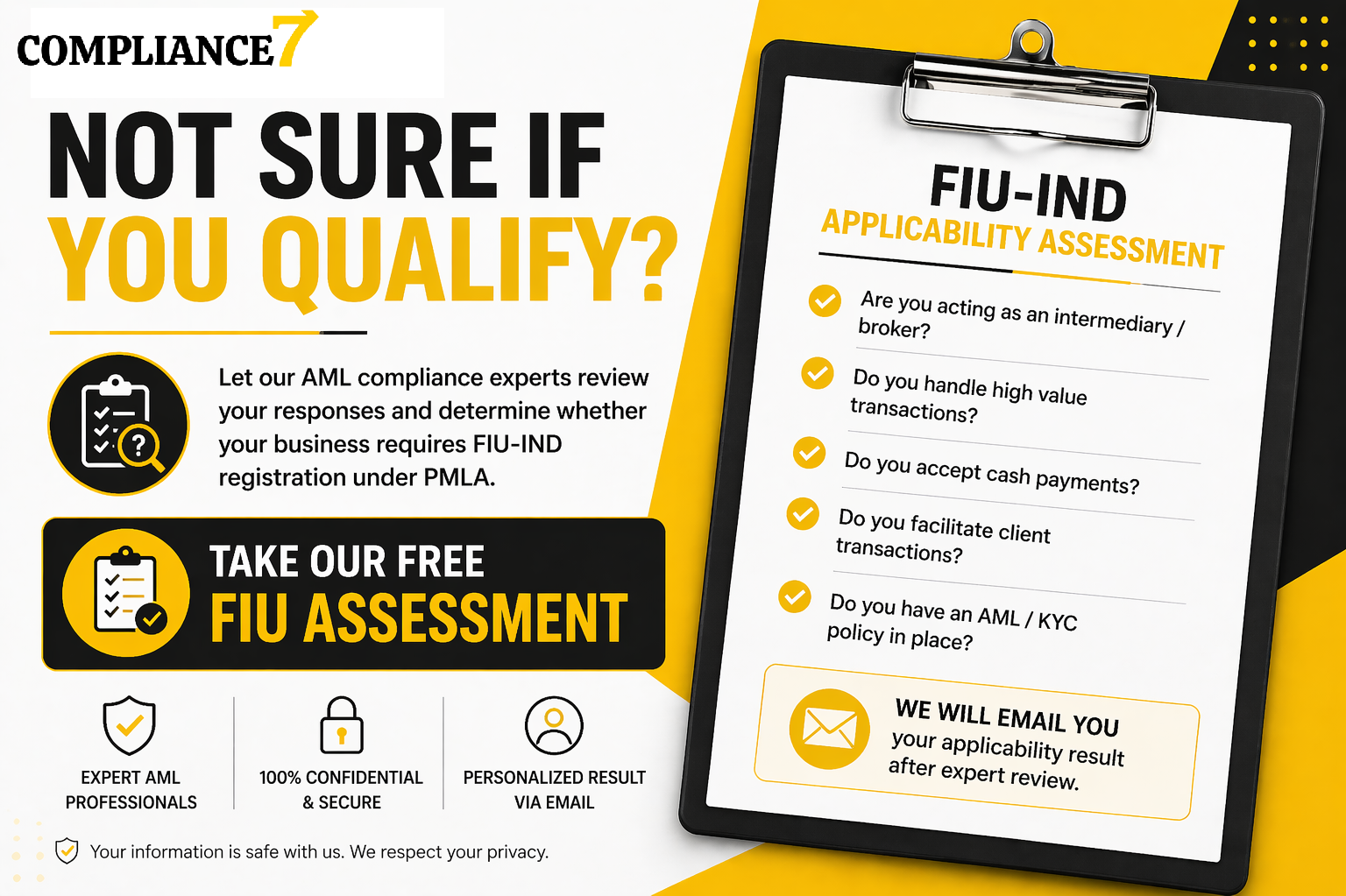
If you are unsure whether your business qualifies as a reporting entity, a structured applicability assessment can help clarify your obligations based on your specific business model. Compliance7 provides FIU-IND applicability reviews tailored for real estate professionals, helping you determine whether registration is required and what steps to take next.
Designated director vs. Principal officer
The Designated Director is a board-level or senior management official responsible for overall PMLA compliance. For sole proprietorship firms, this is typically the proprietor. The Principal Officer is the person responsible for day-to-day AML/CFT operations, including filing reports with FIU-IND, maintaining records and overseeing the CDD program. Both roles can be held by the same person in smaller firms, but the appointments must be formally documented and communicated to FIU-IND.
Compliance obligations for real estate agents under PMLA
FIU-IND registration is only the starting point. Once registered, real estate agents must maintain an ongoing compliance program that covers several critical areas.
Customer due diligence (CDD) and KYC
Every real estate agent must implement a robust CDD program. At a minimum, this means verifying the identity of every client before facilitating a property transaction. For individuals, this involves collecting government-issued photo identification and proof of address. For companies, trusts or partnerships, the agent must identify the beneficial owners, meaning the natural persons who ultimately own or control the entity.
Enhanced due diligence (EDD) is required for higher-risk clients. This includes politically exposed persons (PEPs), clients from jurisdictions with weak AML controls and transactions involving complex or unusual structuring. The agent must document the purpose of the transaction and the source of funds, particularly for high-value deals at or above the ₹50 lakh mark.
Transaction monitoring and reporting
Real estate agents must monitor all client transactions for unusual patterns. If a transaction appears inconsistent with the client’s known profile or if there are grounds to suspect that funds are linked to criminal activity or terrorist financing, the agent must file a Suspicious Transaction Report (STR) with FIU-IND promptly, within the timelines prescribed under applicable regulations.
Beyond STRs, agents may also need to file Cash Transaction Reports (CTRs) for cash transactions exceeding ₹10 lakh (INR 1 million) in a month and Non-Profit Organisation Transaction Reports (NTRs) where applicable. All reports are submitted through the FINnet 2.0 portal in the prescribed electronic format.
Record keeping
The PMLA requires reporting entities to maintain complete records of all client information, CDD documentation and transaction details. These records must be preserved for a minimum of five years after the business relationship ends or after the date of the transaction, whichever is later. Records should be sufficient to permit reconstruction of individual transactions so as to provide evidence for prosecution of criminal activity, if necessary.
Sanctions screening
The Ministry of Home Affairs Order dated 2 February 2021 prohibits real estate agents from engaging in transactions with individuals or entities on the sanctions list or those associated with banned organizations and terrorists. Agents must screen their clients against applicable sanctions lists before proceeding with any transaction.
Common money laundering red flags in real estate
Recognizing suspicious activity is a core compliance skill for real estate agents. Several patterns should trigger closer scrutiny and potential STR filing.
Transactions where the buyer insists on paying a significant portion in cash deserve attention. Similarly, deals where the purchase price appears significantly above or below market value may indicate an attempt to layer illicit funds. Third-party payments, where someone other than the buyer or seller provides funds without a clear legal relationship, are another warning sign.
Rapid buying and selling of properties by the same individual or purchases made through multiple shell companies with opaque ownership structures should raise concerns. Clients who are reluctant to provide identification documents, who provide inconsistent information about the source of funds or who pressure the agent to expedite the transaction without proper documentation all warrant heightened scrutiny.
Transactions involving properties in jurisdictions with known AML deficiencies, as identified by FATF, also carry elevated risk. Agents should consult the latest FATF grey list and high-risk jurisdiction updates when assessing geographic risk.
Penalties for non-compliance with FIU-IND registration
The consequences of ignoring your FIU-IND obligations are serious. The PMLA provides for both monetary penalties and criminal prosecution for reporting entities that fail to comply.
Under Section 13 of the PMLA, the Director of FIU-IND can impose a monetary penalty of up to ₹1 lakh (INR one hundred thousand) for each instance of failure to furnish prescribed information, maintain records or comply with reporting obligations. While ₹1 lakh per violation may seem modest, penalties accumulate quickly when multiple transactions are involved. Systemic non-compliance over several years can result in aggregate penalties running into larger fines.
More seriously, Section 13 also empowers the Director to issue warnings, direct specific actions or bar persons from conducting regulated business. Administrative penalties may be imposed for non-compliance with reporting obligations. Criminal penalties, including imprisonment, apply in cases involving offenses of money laundering under the PMLA.
The reputational damage should not be underestimated either. Enforcement actions are a matter of public record and non-compliance findings can damage an agent’s standing with clients, RERA authorities and business partners.
How real estate agents can get compliant
Getting compliant with FIU-IND requirements does not need to be overwhelming. A structured approach makes the process manageable, even for smaller firms.
Start with FIU-IND registration. Visit the FINnet 2.0 portal, create your entity account, and submit the required details. Appoint your Designated Director and Principal Officer and communicate their details to FIU-IND.
Next, develop your AML/CFT policy. This document should outline your firm’s approach to client acceptance, CDD procedures, transaction monitoring, STR filing, record keeping and staff training. It needs to be practical, proportionate to your firm’s size and risk exposure and consistently followed.
Implement a CDD program that covers identity verification for all clients, beneficial ownership identification for corporate buyers, risk categorization based on client profile and transaction type and ongoing monitoring of the business relationship. Maintain all CDD records in an organized, retrievable format.
Train your staff. Everyone in your firm who interacts with clients or processes transactions should understand the basics of AML compliance, know how to recognise red flags and know the process for escalating concerns to the Principal Officer.
Finally, establish a reporting process. Ensure your Principal Officer knows how to file STRs, CTRs and other prescribed reports through FINnet 2.0. Test the process before you need it. Filing your first STR under time pressure, with no prior experience using the portal, creates unnecessary compliance risk.
Frequently Asked Questions (FAQs)
Do all real estate agents need FIU-IND registration?
Not all real estate agents are required to register. Applicability depends on whether the agent qualifies as a reporting entity under PMLA, based on the nature of services provided and involvement in property transactions. In practice, agents meeting regulatory thresholds such as RERA registration (e.g., ₹20 lakh turnover) are more likely to fall within scope.
Does the ₹50 lakh rule apply to agents or only to property registrars?
Property Transaction Reports (PTRs) for properties valued at ₹50 lakh or above are filed by property registrars. However, real estate agents have independent obligations. If you facilitate a transaction at or above ₹50 lakh, you must conduct enhanced CDD on all parties and file an STR if any suspicious elements are identified. The ₹50 lakh threshold is a trigger for heightened scrutiny, not just a registrar’s reporting requirement.
What if I only facilitate rental transactions?
The notifications refer to services related to the “sale or purchase” of real estate. Rental-only agents may not fall within the current definition. However, if your business also involves sale or purchase facilitation, even occasionally and your overall turnover exceeds ₹20 lakh, registration is required. Consult a compliance professional if your business model sits on the boundary.
Can one person serve as both Designated Director and Principal Officer?
Yes, particularly in smaller firms or sole proprietorships. The key requirement is that the appointments are formally made, documented and communicated to FIU-IND.
Taking the next step
FIU-IND registration for real estate agents is not a future possibility. It is a current requirement backed by the full weight of the PMLA. The ₹50 lakh threshold adds specific reporting triggers that every property professional must understand and operationalize. Regulators are watching, FATF has flagged real estate as a priority sector and India’s mutual evaluation results depend partly on how effectively DNFBPs like real estate agents implement their AML/CFT obligations.
The cost of compliance is modest compared to the cost of penalties, enforcement action or reputational harm. Starting now puts you ahead of the curve. FIU-IND applicability is ultimately determined based on the specific facts and business model of each entity. Businesses should undertake a case-by-case assessment. Many real estate agents remain unaware of their obligations under PMLA, leading to unintentional non-compliance.
If you need help with FIU-IND registration, AML/CFT policy development, or ongoing compliance support for your real estate business, Compliance7’s team of CAMS-certified consultants can guide you through every step. Book a free consultation today.
This article is for informational purposes only and does not constitute legal or regulatory advice. For guidance specific to your business, consult a qualified compliance professional.