
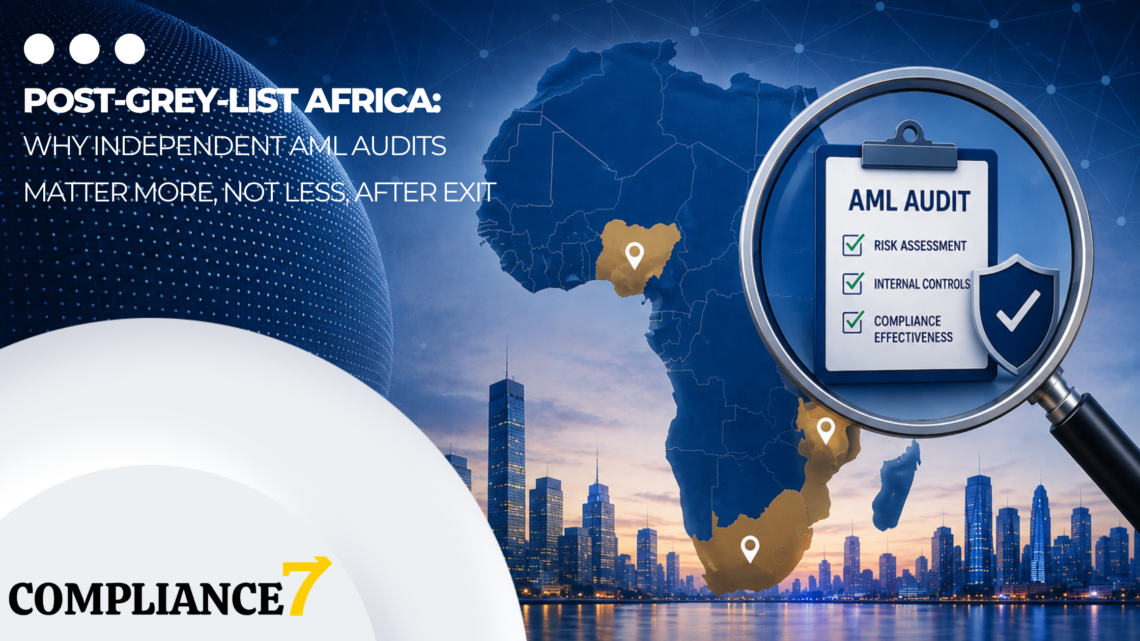
Independent AML Audits in Africa are becoming increasingly important as businesses respond to evolving regulatory expectations and a changing FATF landscape.
Nigeria and South Africa have exited the Financial Action Task Force (FATF) list of jurisdictions under increased monitoring, commonly known as the FATF grey list. Their removal in October 2025 marked an important milestone after years of regulatory reform and efforts to strengthen their anti-money laundering, counter-terrorist financing and counter-proliferation financing frameworks.
For businesses operating across Africa, however, FATF exit should not be confused with the end of compliance work. Instead, the post-grey-list environment creates an important question for regulated entities:
Can the organisation demonstrate that its AML/CFT controls are actually working?
Organisations can write policies, complete risk assessments, train employees and implement technology. However, these measures alone do not prove that a compliance program is effective. This is where independent AML audits and objective AML/CFT reviews become increasingly valuable. For financial institutions, fintech companies, payment service providers, virtual asset businesses and other regulated entities in South Africa, Nigeria, Kenya and other African markets, the challenge is moving beyond documented compliance towards demonstrable compliance effectiveness.
FATF exit is a milestone, not a compliance finish line
Nigeria and South Africa were removed from FATF increased monitoring in October 2025 after completing their respective action plans. The same FATF Plenary also removed Burkina Faso and Mozambique from increased monitoring.
FATF recognised the progress made by these jurisdictions in addressing the strategic deficiencies identified during their monitoring process. Following their removal, Nigeria continues working with the Inter-Governmental Action Group against Money Laundering in West Africa (GIABA). South Africa, as a FATF member, continues working with FATF in coordination with the Eastern and Southern Africa Anti-Money Laundering Group (ESAAMLG) to sustain improvements in its AML/CFT system.
That distinction matters. A FATF grey-list exit reflects progress in a country’s AML/CFT system. It does not mean that every financial institution, fintech company or regulated business within that country automatically has an effective compliance program. Individual organisations remain responsible for meeting the laws, regulations and supervisory expectations that apply to their activities. For regulated entities, the post-grey-list environment should therefore shift the focus from simply asking whether the organisation has implemented an AML program to asking whether that program is producing the intended results.
This is the difference between compliance on paper and compliance in practice. For example, a business may have a detailed AML policy, but staff may not apply customer due diligence consistently. A transaction monitoring system may also operate with poorly calibrated scenarios or thresholds. Employees may complete AML training without fully understanding how to identify and escalate suspicious activity.
Internal document reviews alone often fail to identify these weaknesses. An independent AML review provides an opportunity to test the program objectively.
Why independent AML audits matter more after grey-list exit
During periods of significant regulatory reform, businesses often concentrate on implementation. Regulators introduce new requirements, organisations update policies and compliance teams create additional processes.
Once those changes have been implemented, organisations need to ask a different question:
Are the controls working as intended?
From implementation to demonstrable effectiveness
An independent AML/CFT audit or review can help answer that question. A meaningful review should go beyond confirming that policies exist. It should examine whether the organisation’s risk assessment reflects its actual business. It should also assess whether customer due diligence is applied consistently and whether monitoring and reporting processes operate effectively.
The value of independence is particularly important. Internal compliance teams play a critical role in maintaining and improving AML/CFT controls. However, they may also be closely involved in designing or operating those controls. An appropriately independent reviewer can therefore provide a different perspective. The reviewer may identify weaknesses that internal teams have overlooked. The objective is not to criticise the compliance team or simply produce a list of deficiencies. Instead, a well-designed independent review should provide management with a clearer understanding of the organisation’s financial crime risks, the effectiveness of its controls and the areas requiring remediation.
For businesses operating in rapidly evolving markets, independent AML audits can provide valuable assurance and practical insight.
South Africa: From grey-list exit to measurable outcomes
South Africa’s FATF exit was a significant development for the country’s financial system. However, South Africa’s National Treasury has made clear that exiting the grey list is not the end of the country’s AML/CFT reform process. Continued progress will need to be demonstrated through measurable outcomes. These include successful investigations, prosecutions and sanctions relating to AML/CFT.
These outcomes will also form part of the next FATF Mutual Evaluation for South Africa. According to South Africa’s National Treasury, the assessment is expected to commence in the first half of 2026 and conclude in October 2027. This provides important context for regulated entities. The focus increasingly extends beyond the existence of systems and controls to the outcomes those controls produce. South African accountable institutions remain subject to ongoing obligations under the Financial Intelligence Centre Act and the regulatory framework that applies to their activities.
The Financial Intelligence Centre requires accountable institutions to develop and maintain a Risk Management and Compliance Program, commonly referred to as an RMCP. The RMCP should address the money laundering, terrorist financing and proliferation financing risks relevant to the institution. It should also explain how the institution manages those risks. The challenge for businesses is ensuring that the RMCP remains relevant after its implementation.
Nigeria: Building sustainable compliance beyond regulatory reform
Nigeria’s removal from FATF increased monitoring was also an important milestone. FATF recognised significant progress in Nigeria’s AML/CFT system. Nigeria addressed deficiencies identified in its action plan across areas that included risk assessment, risk-based supervision, beneficial ownership, financial intelligence, money laundering investigations and other elements of the country’s AML/CFT framework.
For Nigerian businesses, particularly those operating in financial services and fintech, the next challenge is sustaining effective compliance as businesses grow and regulations evolve. Nigeria’s financial services and fintech sectors continue to develop rapidly. Companies can expand, introduce new products and onboard significant numbers of customers within relatively short periods. That growth can create financial crime risks that existing AML frameworks are not prepared to manage. For example, a customer onboarding process that was appropriate for a small business may become ineffective when volumes increase significantly. Likewise, a manual monitoring process may not remain practical as transaction volumes grow. A customer risk model may also require reassessment when the organisation expands into new markets or introduces new products.
An independent AML audit can provide management with an objective assessment of whether the compliance program has evolved alongside the business. This is one reason why independent AML audits are increasingly relevant to growing financial institutions and fintech businesses.
Kenya: Independent audit and grey-list context
Kenya presents a different but equally important AML/CFT context. Unlike Nigeria and South Africa, Kenya remains subject to FATF increased monitoring. Therefore, Kenya should not be described as part of the post-grey-list group alongside Nigeria and South Africa. However, Kenya is highly relevant to the broader discussion about independent AML testing because its regulatory framework expressly addresses independent audit.
Under Kenya’s Proceeds of Crime and Anti-Money Laundering framework, reporting institutions must establish and maintain internal controls designed to address money laundering, terrorist financing and proliferation financing risks. The Proceeds of Crime and Anti-Money Laundering Regulations, 2023 expressly require reporting institutions to maintain an independent audit function to test the system.
The Regulations also require a reporting institution to adopt an independent audit function to check its compliance with the Act and the Regulations. For Kenyan reporting institutions, independent AML testing is therefore not simply a question of good practice. The organisation must consider how it meets the applicable independent audit requirement. It must also ensure that its broader AML/CFT control environment remains effective.
What should an independent AML review actually test?
An independent AML audit should not be limited to reading policies and confirming that procedures exist. The most useful reviews compare documented controls with operational reality. For example, an organisation’s AML policy may state that enhanced due diligence is required for higher-risk customers. An independent reviewer may then assess whether the organisation correctly identifies higher-risk customers. The reviewer may also assess whether staff complete and document enhanced due diligence as required.
Similarly, a policy may require ongoing monitoring. The review can examine how the organisation conducts monitoring. It can also assess how staff investigate alerts and whether decisions are supported by sufficient evidence. The same principle applies to employee training, suspicious activity reporting and governance.
A policy is a starting point. Evidence of implementation demonstrates whether a control is operating as intended. The organisation’s regulatory obligations and risk profile should determine the scope of an independent AML review. However, a comprehensive assessment may examine governance, risk assessment, customer due diligence, beneficial ownership, enhanced due diligence, screening arrangements, transaction monitoring, suspicious activity escalation, record keeping, training and remediation of previous findings.
The final report should provide more than a list of issues. Management should be able to understand the significance of each finding. It should also understand the relevant control weakness and the practical action required to address it.
Independent AML audits for fintechs and growing financial institutions
Independent AML audits can be particularly valuable for fintech companies and other rapidly growing financial institutions. Growth often creates a gap between the compliance program originally designed for the business and the organisation that the business has become. A startup may initially rely on manual customer onboarding and compliance checks. As customer numbers increase, the organisation may automate those processes. It may also introduce new technology vendors or launch products across different jurisdictions. Each change can affect the organisation’s financial crime risk profile.
An independent review can help management identify whether existing controls remain appropriate. It can also provide useful insight before significant events such as international expansion, investment rounds, banking relationships, licensing applications or major technology implementations. The purpose is not to guarantee regulatory approval or a particular outcome. Instead, the review provides an opportunity to identify weaknesses early and develop a structured remediation plan.
Beyond independent AML audits: Building an effective compliance framework
An independent AML review can identify gaps, but organisations may also require support to address the underlying issues. This is where broader AML/CFT compliance services become important. Depending on the organisation’s needs, Compliance7 can support businesses with AML/CFT gap assessments, risk assessments, policy and procedure development, KYC and customer due diligence frameworks, enhanced due diligence processes, compliance remediation and AML/CFT training. For businesses expanding into new markets, Compliance7 can also support regulatory and compliance readiness assessments.
The objective is to help organisations build compliance frameworks that reflect their actual risks and operations. Generic AML policies copied from another organisation rarely provide an effective long-term solution. Instead, a strong AML program should connect the organisation’s risk assessment to its policies, procedures, technology, governance and day-to-day operational decisions. Independent testing then provides an important mechanism for assessing whether those elements work together in practice.
AML compliance support across Africa
For financial institutions, fintech companies, payment service providers, virtual asset businesses and other regulated entities, AML/CFT compliance should be treated as an ongoing process rather than a one-time project. As regulations evolve and businesses grow, organisations should review and update their compliance frameworks accordingly.
Our services include independent AML/CFT reviews, compliance gap assessments, AML/CFT risk assessments, policy and procedure development, KYC and customer due diligence support, enhanced due diligence frameworks, compliance remediation, governance advisory and AML/CFT training.
Every organisation operates differently. For this reason, our approach focuses on understanding the business, its risk profile and the regulatory environment before defining an appropriate scope of work. For jurisdiction-specific legal advice or interpretation of local regulatory requirements, organisations should consult appropriately qualified legal or regulatory professionals.
If your organisation operates in South Africa, Nigeria, Kenya or another African market and requires independent AML audits, AML reviews or broader AML/CFT compliance support, Compliance7 can help assess your needs and define an appropriate scope of work.
This article provides general information and does not constitute legal advice. AML/CFT obligations vary depending on the jurisdiction, regulatory status, business activities and applicable supervisory requirements. Organisations should obtain appropriately qualified legal or regulatory advice where jurisdiction-specific interpretation is required.