
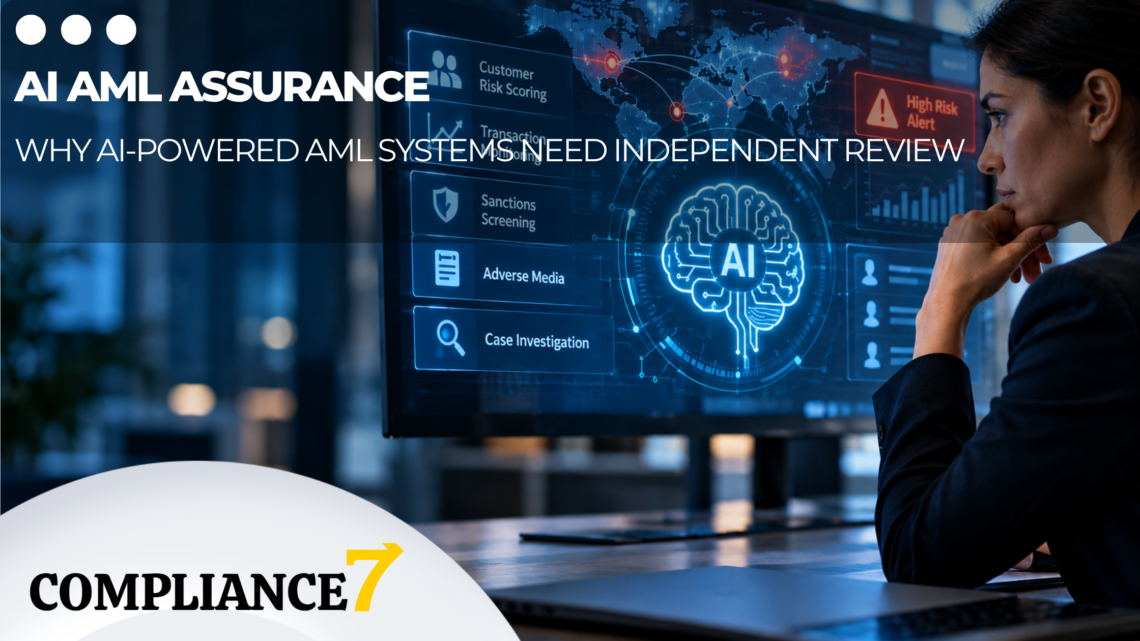
AI AML assurance is the independent review of how artificial intelligence is governed, used and performed within a firm’s anti-money laundering controls. It matters because AI is increasingly embedded in many of the AML controls that matter most: customer risk scoring, transaction monitoring, sanctions screening, adverse media and case investigation. Used well, AI can make those controls faster and more effective. However, without appropriate oversight, AI-enabled controls can fail quietly, at scale, in ways that may not be immediately visible.
One principle has not changed. Using AI or buying it from a vendor, does not by itself transfer a regulated entity’s AML/CFT responsibilities. The organisation remains responsible for maintaining appropriate governance, oversight and controls over its AML programme, including the AI inside it.
That is why independent review of AI-powered AML systems matters. This article explains what an independent AI AML assurance review should cover, why each area matters and how regulatory thinking is developing in major jurisdictions.
Key takeaways
- AI does not transfer accountability – The regulated entity retains responsibility for its AML/CFT programme, including AI supplied by third parties, with accountability allocated across the board, senior management, the MLRO or Principal Officer and other control functions under the applicable framework.
- Some of the most significant AI risks in AML can be difficult to detect – Missed risk (false negatives), model drift, weak data, AI bias and unexplainable decisions may not become apparent until an inspection, an enforcement action or a financial-crime incident.
- Regulatory frameworks increasingly address common themes – Instruments from the CBUAE, the EU, US banking agencies and the RBI cover governance, explainability, human oversight, data management and control of third-party AI, though their legal status and specific requirements differ.
- Some frameworks have explicit scope limits – The 2026 US interagency model risk guidance, for example, states that generative and agentic AI models are outside the scope of that guidance, while noting that banking organisations should establish appropriate governance and controls for tools and systems outside its scope.
- Independent assurance gives decision-makers evidence, beyond vendor representations, about whether AI-enabled AML controls are appropriately governed and operating as intended.
What is AI AML assurance?
AI AML assurance is an independent, objective review of whether the artificial intelligence and machine learning used in an AML/CFT programme are properly governed, fit for the organisation’s risk profile, and designed and operating effectively to support its AML/CFT obligations. It covers machine learning models, rules-based systems enhanced with AI, generative AI tools used by compliance teams and AI embedded in vendor platforms.
AI AML assurance fills a gap between two established disciplines:
- An independent AML audit tests the overall programme: policies, risk assessment, CDD, monitoring and reporting. It rarely looks inside the models that now drive those controls.
- Model validation tests statistical soundness and performance. It rarely asks whether the outputs meet AML obligations, reflect the firm’s actual money laundering and terrorist financing risks or can be evidenced to a supervisor.
AI AML assurance connects the two. The core question is simple: can the organisation stand behind the AML outcomes its AI produces? In this article, “assurance” means an expert, independent review. It is not a statutory audit, a formal attestation engagement or a certification of regulatory compliance.
Where AI now shapes AML decisions
Firms increasingly use AI across different stages of the AML lifecycle, often inside tools firms buy rather than build. Each use carries a different consequence if it goes wrong.
| AML process | How AI is typically used | What is at stake if it fails |
|---|---|---|
| Onboarding and KYC/KYB | Document verification, liveness and biometric checks, entity resolution | Synthetic or false identities enter the customer base |
| Customer risk assessment | Machine learning risk scores and segmentation | Wrong risk ratings drive the wrong level of CDD or EDD |
| Transaction monitoring | Anomaly detection, alert scoring, prioritisation and suppression | Suspicious activity goes undetected and unreported |
| Sanctions and PEP screening | Fuzzy matching, false-positive reduction, automated alert closure | A sanctioned party is onboarded or transacted with, or relevant PEP risk is missed |
| Adverse media | Natural language processing, classification and GenAI summaries | Relevant risk is missed or misrepresented |
| Investigations and reporting | GenAI case summaries and STR/SAR narrative drafting | Inaccurate filings and exposure of confidential information |
| Blockchain analytics (VASPs) | Wallet risk scoring and cluster attribution | Exposure to illicit or sanctioned funds is misjudged |
Why AI does not automatically make an AML programme more effective
Deploying AI does not, by itself, make an AML programme more effective. The FATF made the same point when it reviewed new technologies for AML/CFT: the benefits depend on the conditions, policies and practices that surround them.
In practice, five failure patterns explain why.
Efficiency is not effectiveness
Fewer false positives is visible success. More false negatives, however, is invisible failure. For example, a firm that tunes a model to cut alert volumes can also suppress the alerts that matter and nobody sees the suspicious transaction report the firm never filed.
Models can inherit historical blind spots
Where a firm trains or calibrates a model on past alerts, investigations or reports, the model can inherit the blind spots in that history. As a result, new or evolving typologies, such as money mule networks, authorised push payment fraud proceeds or layering through virtual assets, may not be well represented in the historical data on which the model was trained or calibrated.
Performance decays over time
Customer behaviour, products, payment channels and criminal methods change. Consequently, a model that performed well at go-live may become less effective over time as underlying conditions and risk patterns change.
Vendor models can be opaque
Many AI capabilities arrive inside third-party platforms. If the firm cannot explain why the system rated a customer low risk or closed an alert, it will struggle to demonstrate that the decision was appropriate.
Generative AI adds new risks
GenAI produces fluent text that can still be wrong. In AML, that means inaccurate case summaries, overstated or understated adverse media findings and SAR/STR narratives that misstate facts. In addition, GenAI can create confidentiality and data-protection risks and, depending on the circumstances and applicable law, tipping-off risk when staff submit customer data or suspicious-activity information to external AI services.
What an independent AI AML assurance review should cover
A credible review looks at the whole system around the model, not just the model. The ten areas below are key areas to consider when assessing the governance and effectiveness of AI-enabled AML controls and why each one matters.
1. Governance, ownership and accountability
Each material AI use in the AML programme should have a named owner, a documented purpose, appropriate approval and a place in an inventory. This matters because board and senior management oversight of the AML programme is a core expectation of AML/CFT frameworks. If the firm cannot identify where AI is used, who approved it or who is responsible for managing it, this can create a significant governance and control gap.
2. Alignment with the firm’s ML/TF risk assessment
An AI system should be designed around the risks the institution actually faces: its customers, products, channels and geographies. For example, a model built for retail card fraud will not detect trade-based money laundering. Similarly, a generic vendor model may not reflect the firm’s enterprise-wide risk assessment. As a result, misalignment means the control can look sophisticated while missing the firm’s most relevant risks.
3. Data quality, completeness and lineage
AI is only as reliable as the data it receives. For example, missing fields, unmapped transaction types, incomplete customer records or broken data feeds can remove whole populations from monitoring without any error message. Assurance over data therefore matters because data gaps can be a significant and difficult-to-detect cause of AML control failure.
4. Detection effectiveness and false negatives
Alert volumes alone are not a measure of effectiveness. The more important question is whether the system identifies relevant activity appropriately for the institution’s risk profile. The firm should therefore justify any reduction in false positives, alert suppression or automated closure against the risk of missed suspicious activity. Failures here can create significant regulatory, financial and reputational exposure.
5. Explainability and documentation
Compliance teams should be able to understand and appropriately explain why the system rated a customer, raised or closed an alert, or cleared a screening match. Explainability matters because firms need to justify material decisions to supervisors and auditors, and because investigators need sufficient understanding of an AI output to exercise informed judgement.
6. Fairness and consistency
AI outputs should not create unjustified differences in how customers or cases are treated. For instance, bias in risk scoring or screening can contribute to discriminatory de-risking, unfair treatment of customers and inconsistent application of CDD and EDD. Regulatory and responsible-AI frameworks increasingly address fairness, bias and discriminatory outcomes as areas requiring appropriate governance and control.
7. Human oversight and decision rights
The organisation should define which AML decisions AI may take, which it may only recommend and where a human must decide. Meaningful oversight means reviewers have the authority, time and information to challenge the output, not just approve it. Otherwise, human review becomes a formality and accountability becomes unclear.
8. Change management and ongoing performance
Models, thresholds, data sources and vendor versions change over time, and each change can alter AML outcomes. Performance also drifts as customer behaviour and typologies evolve. The firm therefore needs to know who made each change, who approved it and whether the system still performs as intended.
9. Third-party and vendor AI
Outsourcing the technology does not outsource the obligation. Firms therefore need sufficient information, contractual rights and oversight to understand how a vendor’s AI works, how it is changed and how it performs on their own data. Heavy reliance on an opaque vendor model can create a significant governance and assurance gap.
10. Generative AI controls, confidentiality and records
Where compliance staff use GenAI for case notes, EDD summaries, adverse media reviews or STR drafting, the firm needs controls over accuracy, approved tools, data handling and review. The firm should also protect confidential AML information, particularly anything that could reveal a suspicion, through appropriate access, data-handling and information-security controls. Every material decision also needs a record of how it was reached, supporting the firm’s ability to demonstrate compliance to supervisors and auditors.
What regulators and standard-setters expect
Regulators and standard-setters increasingly address AI in financial services, with common themes including governance, accountability, explainability, human oversight, data management and control of third-party AI. Their legal status, scope and specific requirements differ by jurisdiction.
| Jurisdiction | Instrument | What it signals for AI in AML |
|---|---|---|
| Global | FATF, Opportunities and Challenges of New Technologies for AML/CFT (July 2021) | Technology can improve AML/CFT efficiency and effectiveness, but only with the right conditions, policies and practices, and with data protection respected. |
| Global (industry) | Wolfsberg Principles for Using AI and ML in Financial Crime Compliance (December 2022) | Industry principles, not regulation. Five elements: legitimate purpose, proportionate use, design and technical expertise, accountability and oversight, and openness and transparency. |
| India | RBI FREE-AI Committee Report (13 August 2025) | A committee recommendations framework, not a binding RBI direction. Sets out 7 Sutras and 26 recommendations across six pillars, including governance, protection and assurance. |
| India | RBI draft Guidance on Regulatory Principles for Model Risk Management, 2026 (draft issued 24 June 2026 for consultation) | Draft only. Proposes board-approved model risk frameworks covering AI/ML and third-party models, with independent validation, human oversight and accountability for outcomes. |
| UAE | CBUAE Guidance Note on the Consumer Protection and Responsible Adoption and Use of Artificial Intelligence and Machine Learning by Licensed Financial Institutions (February 2026) | Principles-based guidance for licensed financial institutions, not an AML-specific rule. Covers governance and accountability, fairness, transparency and explainability, human oversight, and data management and privacy. Relevant where AI/ML sits within AML/CFT controls. |
| European Union | AML Regulation (EU) 2024/1624, Article 76(5) (applies from 10 July 2027) | Permits certain decisions resulting from automated processes or AI systems, subject to conditions including meaningful human intervention for specified customer decisions and the customer’s ability to obtain an explanation and challenge the decision, subject to the Regulation’s exceptions. |
| United States | Interagency Revised Guidance on Model Risk Management (17 April 2026) | Applies to covered US banking organisations, not to all US AML-regulated businesses. Replaces SR 11-7 and the 2021 BSA/AML model risk statement with principles-based, risk-proportionate guidance. Generative and agentic AI are outside its scope, with further agency work on AI signalled. |
What this means in practice
Regulatory note: The instruments above differ in legal status, scope, applicability and timing. Several are principles, recommendations or drafts, and the detail will continue to evolve. None of them makes an independent AI AML assurance review mandatory in every jurisdiction or for every regulated entity. Equally, gaps such as the US treatment of generative AI do not reduce a firm’s obligation to maintain an effective AML programme. For entities outside these specific regimes, such as VASPs and DNFBPs, the underlying AML/CFT obligations apply whatever tools a firm uses.
Signs your organisation needs AI AML assurance now
If any of the following apply, an independent review may be appropriate:
- You use, or plan to deploy, AI in transaction monitoring, screening, customer risk scoring or adverse media.
- Alert volumes fell sharply after a model or vendor change and nobody can show what the system stopped detecting.
- Your vendor describes its model as proprietary and cannot explain individual outcomes.
- Staff use generative AI tools for case notes, EDD summaries or STR drafting without an approved policy.
- Your board or MLRO relies on vendor reports rather than independent evidence that AI-driven controls work.
- Nobody has reviewed model performance since go-live.
- A regulatory inspection, licence application, independent AML audit or major system migration is approaching.
Why independence matters
Assurance is only as strong as the objectivity behind it. For AI in AML, four reasons make independence important.
Independence removes the self-review problem
Developers and vendors naturally test what they built against their own assumptions. An independent reviewer, by contrast, starts from the firm’s obligations and risks, not from the model’s design.
Independent review combines two rarely paired skill sets
Data science teams understand models but not always AML obligations. Conversely, AML teams understand typologies and regulatory expectations but not always models. Meaningful assurance therefore needs both.
Independent review adds objective challenge
Regulatory frameworks increasingly emphasise validation, oversight and independent challenge, as the RBI’s 2026 draft model risk guidance illustrates, although requirements differ by jurisdiction. Independent evidence also gives boards, senior management and supervisors a source of challenge beyond internal or vendor self-assessment.
Independent review gives the board a basis for real challenge
Finally, directors can approve, restrict or retire an AI use on the strength of an objective view, rather than a vendor’s marketing or an internal team’s confidence.
Frequently asked questions (FAQ)
What is AI AML assurance?
AI AML assurance is an independent review of whether AI and machine learning used in an AML/CFT programme are properly governed, aligned with the firm’s risks, and designed and operating effectively to support its AML/CFT obligations.
Is AI allowed in AML compliance?
AI can be used in AML compliance, subject to applicable legal, regulatory, data-protection and governance requirements. The FATF and industry bodies recognise that technology can improve the efficiency and effectiveness of AML/CFT when appropriate conditions and controls are in place.
If we use a vendor’s AI, is the vendor responsible for AML failures?
Not by itself. Outsourcing the technology does not transfer the regulated entity’s AML/CFT responsibilities, although contractual liability between the firm and its vendor is a separate matter. Using a third-party model increases the need for appropriate oversight, because the firm must have sufficient information to assess the system’s suitability, understand its material outputs and justify its reliance on the technology.
How is AI AML assurance different from model validation?
Model validation focuses on statistical soundness and performance. AI AML assurance also asks whether the AI supports the firm’s AML obligations, reflects its ML/TF risks, is governed and overseen properly, and produces decisions the firm can explain and evidence.
How is it different from an independent AML audit?
An independent AML audit reviews the whole AML programme. AI AML assurance goes deeper into the AI-enabled controls within it, which a standard audit may not examine in detail.
When should an AI AML assurance review take place?
On a risk-based basis. Common trigger points are before go-live, after a material model or vendor change, before a regulatory inspection or licence application, and periodically for high-impact systems.
Does it apply to generative AI tools used by compliance staff?
Yes. GenAI used for case summaries, adverse media reviews, EDD reports or STR drafting carries risks of inaccuracy and confidentiality breaches, so it belongs within scope.
Which organisations should consider AI AML assurance?
Regulated entities where AI or machine learning is material to their AML/CFT controls, particularly in higher-impact use cases. This can include banks, NBFCs, payment and fintech firms, money service businesses, virtual asset service providers and DNFBPs.
How Compliance7 can help
AI can strengthen AML compliance, but only if the organisation can show that its AI-enabled controls are governed, effective and defensible. Compliance7 provides independent AI AML assurance for regulated entities using AI and machine learning in their AML/CFT programmes.
Our reviews bring together AML/CFT regulatory expertise and an understanding of how AI systems behave in practice. We work with fintechs, NBFCs, money service businesses, VASPs and DNFBPs across multiple jurisdictions. The outcome is an independent, evidence-based assessment that helps boards, MLROs, Principal Officers and senior compliance teams understand material AI-related AML risks and control gaps, with clear, prioritised findings.
Talk to us about an AI AML assurance review. Book a confidential scoping conversation.