An AML lookback review involves re-examining historical transactions, alerts or customer records to identify suspicious activity that weaknesses in a firm’s AML controls may have missed. Firms typically start one after identifying a control failure, whether through regulatory intervention, an independent audit or their own internal assessment. By examining the affected period and population, a well-executed lookback helps determine the extent of the exposure, identify previously undetected suspicious activity and assess whether appropriate remedial action has been taken.
This guide explores when an AML lookback review may be necessary and how it differs from an independent AML audit. It examines the key stages of a lookback, including defining the scope, selecting samples, reviewing historical activity, reporting findings and addressing common challenges. As regulatory requirements vary across jurisdictions, firms should tailor their approach to applicable local laws, regulatory expectations and any specific supervisory directions.
Key takeaways on AML lookback reviews
- Purpose: An AML lookback review examines historical transactions, alerts or customer records to identify suspicious activity that control weaknesses may have missed. An independent audit, by contrast, assesses whether AML controls are appropriately designed and operating effectively.
- Common triggers: Monitoring gaps, alert backlogs, missed sanctions list updates, inadequate customer due diligence and system failures may prompt a lookback review.
- Scope: The underlying control failure should drive the review. Firms should establish what went wrong, when it occurred and which customers, products and channels it affected.
- Sampling: Sampling can be appropriate for large populations, provided the firm justifies and documents a method proportionate to the risks. Significant exceptions may warrant expanding the sample or conducting a full-population review.
- Outcomes: Findings may lead to historical STR/SAR filings, customer risk reassessments, customer exits and control improvements. Addressing the root cause is essential to prevent similar failures from recurring.
What is an AML lookback review?
An AML lookback review involves re-examining historical transactions, alerts or customer records to identify suspicious activity that weaknesses in a firm’s AML controls may have missed. For example, a bank or fintech may re-run historical transactions through a corrected transaction monitoring scenario. Similarly, a VASP may re-screen historical blockchain transactions and associated wallet addresses using updated blockchain analytics rules. In that case, it should separate information available at the time of each transaction from risk labels added later. A firm may also re-examine previously closed alerts to identify cases that were not adequately investigated or escalated. The objective is to identify activity the firm should have escalated or reported, and to assess the extent of the historical exposure.
The term is most common in the US, where consent orders issued by FinCEN, federal banking agencies or state regulators may require a “SAR lookback”, sometimes involving an independent consultant. In the UK, historical transaction reviews may form part of a skilled person review under Section 166 of the Financial Services and Markets Act 2000 (FSMA), or broader remediation agreed with the Financial Conduct Authority (FCA). However, a Section 166 review is a broader supervisory tool and does not necessarily involve a historical transaction lookback. For example, the FCA used its skilled person power in 31 cases in 2025/26, of which 12 fell under its Financial Crime panel lot. The published figures do not specify how many involved historical transaction reviews. Other regulators may use different terminology, such as remediation review or historical transaction review.
AML lookback review vs independent audit
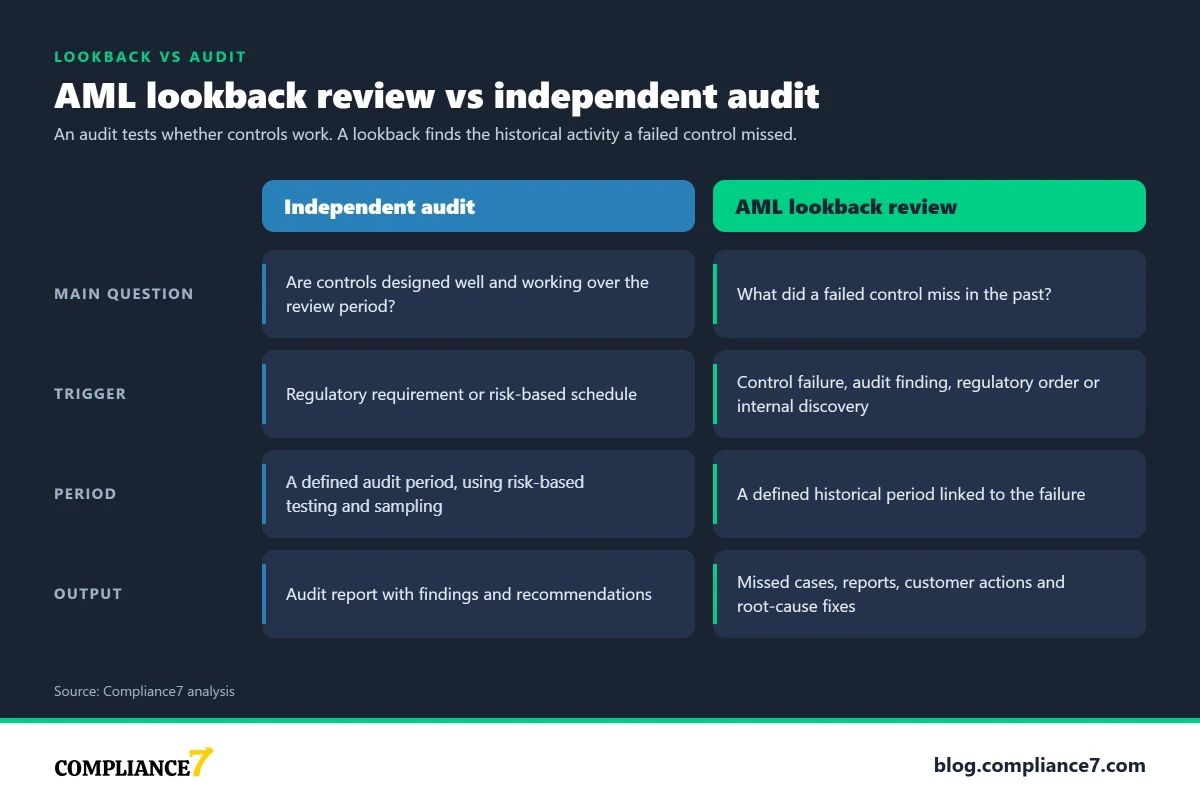
Firms often confuse the two, but they answer different questions. In short, an independent audit assesses whether AML controls are designed well and operating effectively over the period under review. A lookback, by contrast, focuses on finding the historical activity that a failed control missed.
| Aspect | Independent audit | AML lookback review |
|---|---|---|
| Main question | Are AML controls designed well and operating effectively over the review period? | What did a failed control miss in the past? |
| Trigger | Regulatory requirement, policy cycle or risk-based schedule | Control failure, audit finding, regulatory order or internal discovery |
| Period | A defined audit period, using risk-based testing and sampling | A defined historical period linked to the failure |
| Typical work | Control testing, walkthroughs and sample checks | Re-running data, re-reviewing alerts, files or screening results |
| Output | Audit report with findings and recommendations | Missed cases, reports on historical activity, customer actions and root-cause fixes |
| Who performs it | Independent internal or external reviewer | Internal team with QA, or an external party where required |
In practice, the two often connect. For instance, an independent audit may find that a monitoring rule never fired, and that finding then triggers a lookback. However, one does not replace the other. Our AML independent audit guide covers the audit side in detail.
When is an AML lookback review needed?
An AML lookback review usually starts in one of three ways.
Regulator-mandated lookbacks
First, a regulator may require one through an enforcement action, consent order or supervisory direction. In that case, the order often sets the period, the population and the deadlines. It may also require an independent consultant to carry out or validate the work. In the US, for example, the OCC has published guidance on independent consultants in enforcement actions (OCC Bulletin 2013-33).
Self-initiated lookbacks
Second, a firm may start a lookback after finding a problem itself. Common triggers include:
- monitoring scenarios that were switched off, misconfigured or set at the wrong thresholds;
- data feed gaps, where some transactions never reached the monitoring system;
- alert backlogs, or alerts closed without adequate review;
- sanctions lists or screening rules that were not updated on time;
- weak customer due diligence for a product, channel or customer segment; and
- a system migration or merger that left gaps in records or monitoring.
A self-initiated lookback is generally a risk-based remediation measure rather than a specific legal requirement. Nevertheless, undertaking one can demonstrate to regulators that the firm takes the underlying issue seriously and is taking steps to address it. Firms should also assess whether the underlying control failure triggers a separate regulatory notification obligation. In addition, a sponsor bank or payment partner may require a fintech or non-bank financial institution (NBFI) to conduct a lookback under contractual terms or its risk management arrangements.
Audit-driven lookbacks
Third, an independent audit or internal audit finding may point to past exposure. In that case, the audit identifies the control gap, while the lookback measures its impact. Our list of common AML audit findings includes several gaps that can lead to one.
Types of AML lookback review
The type of AML lookback review depends on the nature of the control failure. Most reviews fall into one or more of the following categories:
- Transaction lookback: Re-running historical transactions through corrected monitoring rules or reviewing them against newly identified risk indicators.
- Alert lookback: Re-examining previously closed alerts, particularly where investigation quality or alert backlogs are a concern.
- Customer file lookback: Reassessing KYC records, beneficial ownership information or customer risk ratings for an affected group of customers.
- Sanctions screening lookback: Re-screening historical customer or payment records against the sanctions lists and designation information applicable at the time of the activity, including applicable ownership and control rules.
Scoping an AML lookback review
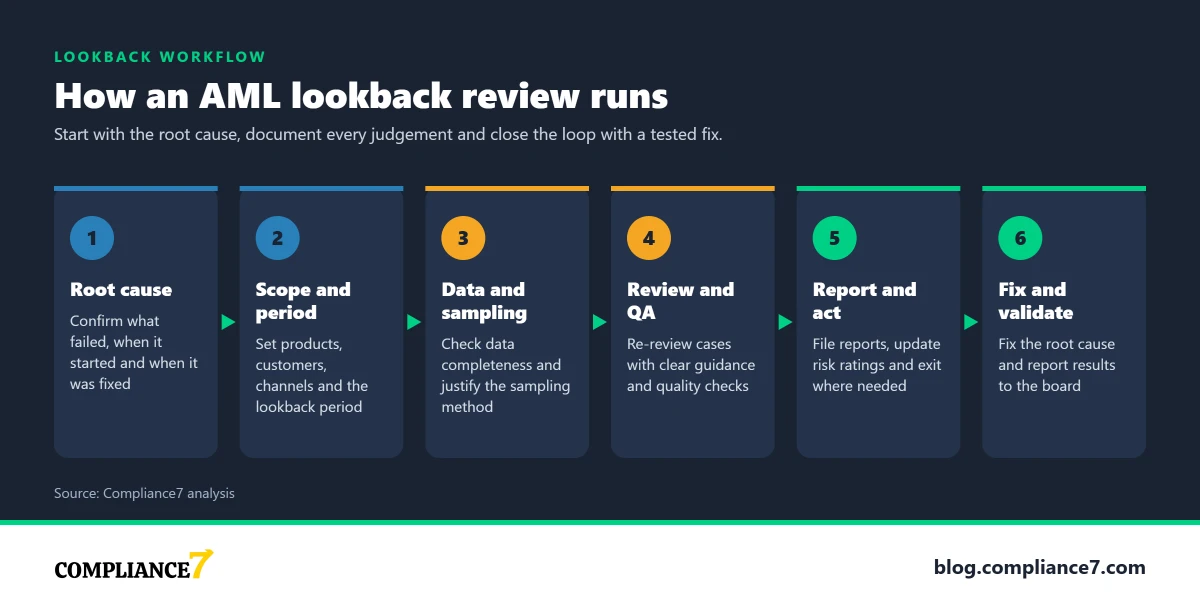
Scope is often where an AML lookback review succeeds or fails. Effective scoping starts with understanding the underlying control failure and identifying its root cause. The firm should establish what failed, when the failure began, when the firm rectified it and which products, customers and channels were affected.
The next step is to define the lookback period. This will generally extend from the point at which the failure began until the corrective measures took effect. Where the start date is uncertain, firms should consider adopting a cautious approach and extending the review period. The firm should also document why it chose the period, as regulators may later scrutinise whether it was appropriate.
Firms must also consider record-keeping requirements. Minimum retention periods are commonly five years, calculated from the transaction date or the end of the business relationship, depending on the applicable rules. However, a minimum retention period does not establish a maximum lookback period, particularly where older records remain available or a regulator directs a longer review. Firms may also need to reconcile archived or migrated data before the review begins.
Finally, the scope should be proportionate to the nature and extent of the failure. Re-reviewing every transaction is not always necessary. For example, a failure affecting a single monitoring scenario for one product may justify a narrowly defined review population. By contrast, a wider data integrity failure may require a broader review covering multiple products, customer groups or channels.
Sampling in an AML lookback review
Where the population is large, firms may use sampling rather than reviewing every item. However, the firm should support its sampling approach with a clear rationale. Common approaches include:
- Risk-based sampling: Focusing on higher-risk customers, products, corridors or transaction value bands.
- Statistical sampling: Selecting a sample designed to support conclusions at a specified confidence level and margin of error. The firm may extrapolate results to the wider population where the sampling design is probability-based, such as random, stratified or systematic sampling, and the relevant statistical assumptions are met.
- Targeted sampling: Focusing on the scenarios, products, customers or typologies linked to the underlying control failure.
- Full-population review: Reviewing the entire population where it is relatively small or the level of risk warrants a comprehensive review.
There is no universally appropriate sample size. The firm should document its sampling methodology, underlying assumptions and acceptable error rate. A risk-based or targeted sample may not be representative of the wider population, so the firm should clearly define how far it can generalise its findings. The sample should also provide adequate coverage of the entire lookback period. If testing identifies a high rate of missed suspicious activity, the firm should consider expanding the sample or moving to a full-population review. Even where the exception rate is low, the firm should assess whether the findings indicate any underlying control weaknesses that warrant further investigation.
Running the review
An AML lookback review is a project, so it needs clear governance. In practice, firms should:
- write a methodology covering scope, period, population, sampling and decision criteria;
- check that the data is complete and accurate before review starts;
- give reviewers clear guidance and examples, so decisions stay consistent;
- apply risk-based quality assurance, covering higher-risk and escalated cases and a sample of other cases;
- track progress, backlogs and decisions in a case management system;
- maintain appropriate independence and objectivity, with safeguards against conflicts of interest;
- check for existing reports on the same customer to avoid duplicates, while assessing whether new activity or information needs an additional or continuing report; and
- involve legal counsel early, especially where the lookback is regulator-mandated.
Technology can help, for instance by re-running corrected scenarios over historical data. The firm should also document why the corrected threshold is defensible, for example through below-the-line testing, which reviews a sample of transactions just below the threshold. Even so, analysts still need to review the resulting alerts and document their reasoning.
Outcomes and reporting
Typically, an AML lookback review produces several outcomes.
Reporting suspicious activity and sanctions matches
First, where the review identifies activity that meets the applicable reporting criteria, the firm should submit a suspicious transaction report (STR), suspicious activity report (SAR) or the local equivalent. Reporting deadlines and their triggers vary by jurisdiction. They may run from the detection of relevant facts, the formation of suspicion or another event set by local law, rather than from the original transaction date. In the US, for example, banks must generally file a SAR within 30 calendar days of initially detecting facts that may constitute a basis for filing. If they have not identified a suspect, they may take an additional 30 calendar days to identify one, but reporting must not be delayed beyond 60 calendar days from the initial detection.
Where local reporting guidance allows, the firm should explain the historical nature of the activity and how the review identified it. It should keep the detailed analysis of the control failure in its internal lookback records. Sanctions matches may require separate action, including asset freezing, breach reporting or voluntary disclosure to the relevant sanctions authority. A historical match does not automatically establish a past sanctions breach. The firm should establish whether the relevant sanctions restrictions applied at the time of the transaction. It should also assess whether the party was owned or controlled, directly or indirectly, by an already-designated person, as applicable ownership and control rules may extend sanctions restrictions to that party. Where the firm holds funds or economic resources subject to an applicable asset-freeze requirement, it must freeze them and report to the relevant authority as required by the applicable sanctions regime.
Customer actions and UK DAML
Second, the firm may need to update customer risk ratings, apply enhanced due diligence or exit customers. When exiting customers, it should manage the risk of tipping off customers about suspicious activity reports. In the UK, where returning or transferring suspected criminal property could amount to a money laundering offence, the firm may need to submit a SAR requesting a defence against money laundering (DAML) from the UK Financial Intelligence Unit (UKFIU), which operates within the National Crime Agency (NCA). The firm must wait for express consent or for the seven-working-day notice period to expire without a refusal before proceeding with the specified activity. If the NCA refuses consent, a 31-day moratorium period applies. A court can extend this period in 31-day increments, subject to the statutory maximum.
Three exemptions may remove the need to obtain a DAML for qualifying transactions. Since 31 July 2025, the operating an account exemption allows banks, building societies, electronic money institutions and payment institutions to carry out certain transactions involving criminal property below £3,000 when operating a customer’s account. The paying away exemption allows a business in the regulated sector to return or transfer a customer’s property when terminating the business relationship, where the criminal property involved is below £3,000 and the applicable customer due diligence requirements have been met.
A separate mixed-property exemption allows qualifying transactions involving funds or property containing both legitimate and suspected criminal property, provided the business retains at least the value of the suspected criminal property, as the legislation requires. These exemptions apply only where their specific statutory conditions are met. They do not remove the separate duty to submit a SAR where section 330 of POCA requires one.
Fixing the root cause and reporting results
Third, it should fix the root cause and test that the fix works. Finally, it should report results to senior management and the board. Where a regulator ordered the lookback, the firm will usually also report to that regulator.
Lookback findings in India
In India, the term “lookback” is not commonly used in FIU-IND or RBI guidance. However, an independent review, inspection or internal discovery can still reveal transactions the firm should have reported. Under Rule 8(2) of the Prevention of Money-laundering (Maintenance of Records) Rules, 2005, as amended in October 2023, the Principal Officer must furnish information on suspicious transactions to the Director immediately upon being satisfied that a transaction is suspicious. The amendment removed the earlier seven-working-day limit, so firms should not treat seven days as a permissible reporting window. Accordingly, firms should promptly file any STRs identified during a lookback and record why the firm missed them. Our guide to STR filing in India covers the reporting process.
Common pitfalls in an AML lookback review
Lookbacks often run into the same problems:
- a scope set too narrowly to meet a deadline;
- no root-cause fix, so the same failure keeps creating new gaps;
- incomplete data, which undermines the whole review;
- inconsistent decisions across reviewers;
- weak documentation of sampling choices and case decisions; and
- missed deadlines, which can worsen the firm’s position with its regulator.
For that reason, an independent party can help with design, quality assurance or validation of the results. That independence matters most where the regulator will rely on the findings.
Worked example: an alert threshold failure
Consider an illustrative case. During a routine review, a payment firm finds that a rule for rapid in-and-out movements had a threshold ten times higher than intended. The error lasted nine months, so the rule generated almost no alerts. The firm would typically:
- confirm the root cause, the start date and the fix date;
- re-run the corrected rule over the nine months of data, which produces, say, 1,200 alerts;
- review the new alerts in full where volumes allow, or sample lower-value alerts with a documented rationale;
- expand the review to linked accounts and counterparties where the review confirms cases;
- file any STRs the review identifies and update customer risk ratings; and
- report the results, root cause and remediation to senior management, and to the regulator where required.
If, say, 40 of the 1,200 alerts result in STR filings, that is about 3.3% of the reviewed alerts. This proportion is one input when judging whether related scenarios need a lookback. However, it is not a standalone measure of control effectiveness, because STR decisions depend on reviewer judgement and on the population the firm reviewed.
Conclusion
An AML lookback review turns a control failure into a structured and documented remediation process. The key is to identify the root cause, establish a defensible scope and document the judgements made throughout the review. When conducted effectively, it helps identify the extent of past control failures, address any resulting exposure and demonstrate to regulators that the firm is taking appropriate steps to identify and remediate weaknesses.
Frequently asked questions (FAQ)
What is the difference between a lookback and an independent audit?
An independent audit tests whether AML controls are designed well and operating effectively over the review period. A lookback re-examines past activity to find what a failed control missed. Often, an audit finding triggers a lookback.
How far back should an AML lookback review go?
Usually, the period runs from when the control failure began until the firm fixed it. Where a regulator orders the lookback, the order often sets the period. Otherwise, the firm should justify its choice and take a cautious view where the start date is unclear.
Can a lookback use sampling?
Yes, where the population is large and the firm can justify its method. However, the firm should widen the sample if it finds a high error rate. Where a regulator mandated the lookback, the firm should also agree the approach with it.
Do STRs need to be filed after a lookback?
Generally, yes. If the review finds activity that meets the applicable statutory criteria for reporting, the duty to report still applies, even though the activity is historical. However, not every flagged transaction will meet those criteria, and a report reflects suspicion, not proof of a crime. Firms should follow local rules on timing and content.
Who should carry out an AML lookback review?
It depends on the trigger and any regulatory direction. Some firms use internal teams with independent quality assurance. Others appoint an external party, especially where the regulator requires independence.
Related Compliance7 guides
- Core guide: AML Independent Audit: Scope, Requirements and Preparation Guide
- Related: 27 Common AML Audit Findings From Our Independent Reviews (and How to Fix Them)
- Related: Money Mule Accounts: AML Controls for Banks, NBFIs and Fintechs
- Related: STR Filing in India: FIU-IND Reporting Requirements, Process and Penalties
Need help assessing a potential AML control failure or conducting a historical transaction review?
Compliance7 supports regulated entities with AML lookback reviews, independent AML audits, transaction monitoring assessments and remediation of control weaknesses. Contact Compliance7 to discuss how we can support your AML compliance requirements.
This article is for informational purposes only and does not constitute legal or regulatory advice. Requirements vary by jurisdiction. For guidance specific to your business, consult a qualified compliance professional.