
Money mule accounts play a significant role in many fraud and money laundering schemes. Criminals use them to receive stolen funds, split them and move them through several accounts before cashing out. So banks, non-bank financial institutions (NBFIs) and fintechs that offer accounts or payment services may all face this risk. However, the nature and extent of that risk vary with each firm’s products, customers and business model.
This guide explains how money mule accounts work, the main typologies and the red flags firms should watch for. It also sets out the AML controls that help detect, stop and report mule activity across the customer lifecycle.
Key takeaways on money mule accounts
- A money mule moves funds for others, often for a commission. Some mules know what they are doing. Others act because criminals deceive or coerce them.
- Mule activity often appears soon after account opening. For example, a 2026 UK FCA review found that 47.1% of suspected mule accounts offboarded in 2025 had been open for less than a year.
- Firms need controls at onboarding, during monitoring and at exit. Inbound monitoring matters as much as outbound monitoring.
- A single red flag rarely proves mule activity. Instead, firms should combine signals across devices, payments and customer behaviour.
- Information sharing between firms and with authorities helps stop funds moving down a chain of mule accounts.
What is a money mule account?
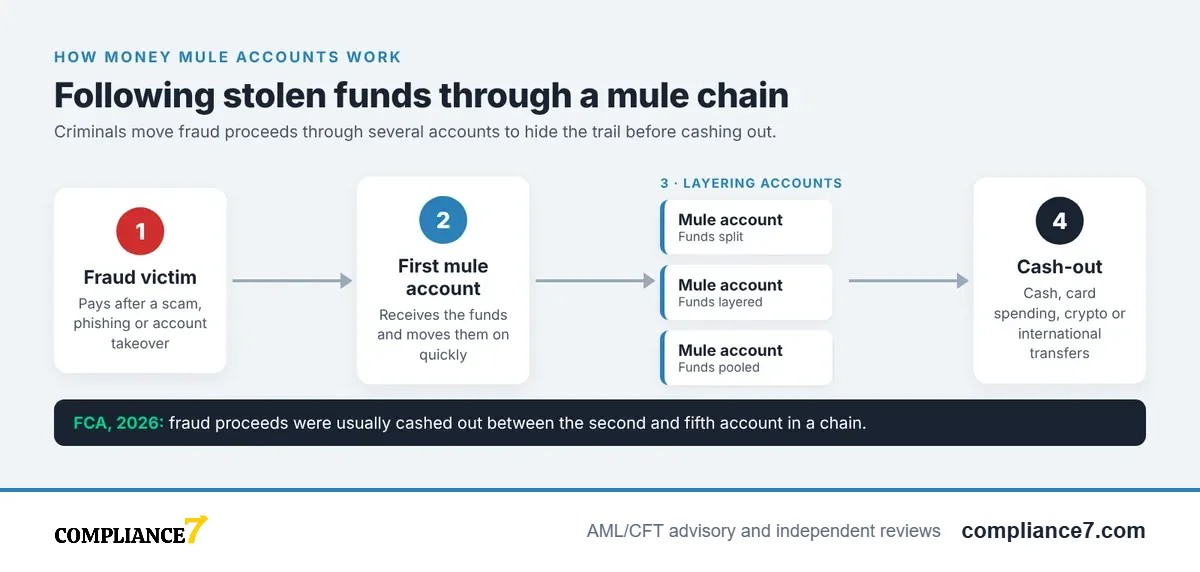
A money mule account receives and passes on funds for someone else. Usually, those funds are the proceeds of fraud or other crime. Europol and the European Banking Federation describe mule networks as moving funds from third parties to other recipients. In return, the mules earn a commission.
Money mule accounts let criminals put distance between themselves and the crime. Funds typically pass through several accounts before criminals cash them out. For instance, a 2026 review by the UK Financial Conduct Authority (FCA) looked at this pattern. Criminals usually cashed out fraud proceeds between the second and fifth account in a chain. That review drew on a survey of 35 firms and an analysis of 140 cases covering seven types of fraud.
Types of money mules and mule-account typologies
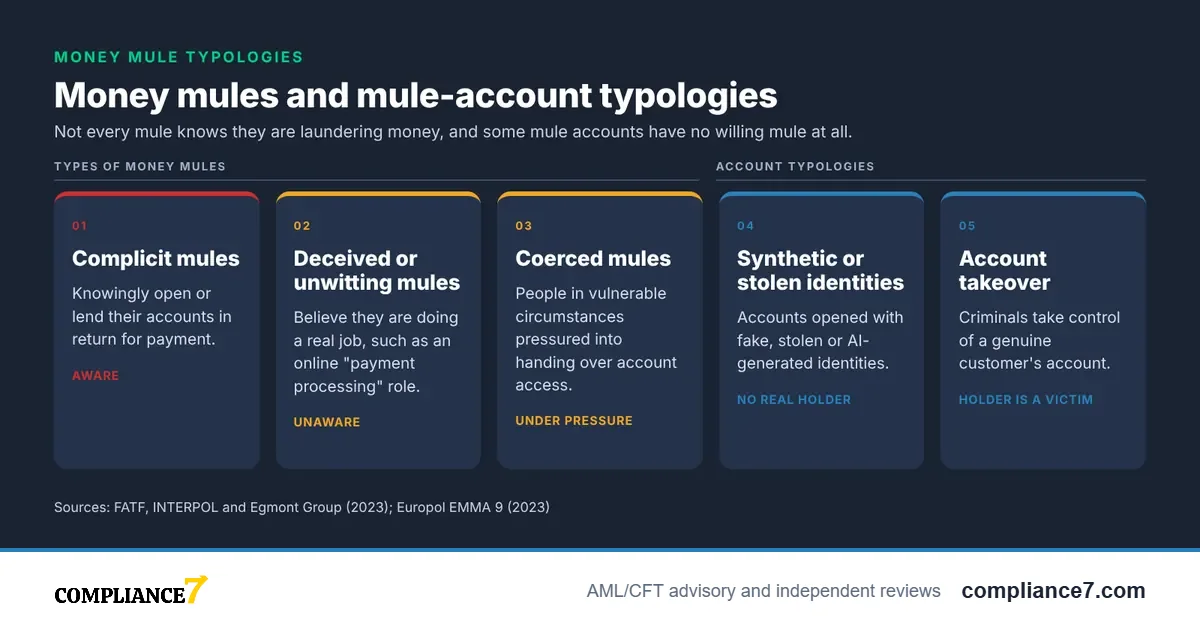
Money mules themselves usually fall into three groups:
- Complicit mules: they knowingly open or lend accounts in return for payment.
- Deceived or unwitting mules: they believe they are doing a legitimate job, such as a “payment processing” role advertised online.
- Coerced or exploited mules: criminals pressure people in vulnerable circumstances into handing over account access. Examples can include some migrants, students or elderly customers.
In addition, mule networks use two account typologies where no willing mule may be involved:
- Synthetic or stolen-identity accounts: criminals open accounts using fake, stolen or AI-generated identities, so no genuine account holder exists.
- Account takeover: criminals gain control of a genuine customer’s account, so the account holder is a victim rather than a mule.
How criminals recruit money mules
Recruitment increasingly happens online. FATF, INTERPOL and the Egmont Group published a joint report on cyber-enabled fraud in 2023. It found that criminals recruit money mules through job offers and social media. In some cases, they also ask mules to act as straw men. Alternatively, they may ask mules to open corporate accounts that hide criminal ownership.
Law enforcement findings show other methods too. Europol’s EMMA 9 operation in 2023 found that criminals coerced people in vulnerable circumstances into opening accounts. It also found organised mules travelling to open accounts with fake documents, and fake identities created to bypass KYC checks. That single operation identified 10,759 money mules, with support from 2,822 banks and financial institutions.
Red flags for money mule accounts
The table below groups common indicators identified in FATF, FCA and Europol publications. However, no single indicator is sufficient to establish money mule activity. Firms should therefore assess multiple indicators collectively and in the context of the customer’s circumstances.
| Area | Red flags |
|---|---|
| Account age and activity | Rapid or high-value activity soon after opening. Large inflows into a new or dormant account, followed by similar outflows. |
| Payment patterns | Many unrelated incoming payments, then quick transfers out. Small test payments followed by larger ones. Funds split across several accounts. |
| Cash-out and onward transfers | Cash withdrawals, card spending or international transfers shortly after funds arrive. Crypto purchases can also be a conversion or onward-transfer channel. |
| Devices and identity | Several unrelated customers using the same device or address without a clear reason. Unexplained gaps between device, IP or login locations and the customer’s declared location. Virtual or shared addresses that do not fit the customer’s stated activity. |
| Customer profile | Activity inconsistent with stated income, occupation or purpose. Signs that the customer is acting on someone else’s instructions. |
| External information | Fraud reports from other institutions. Adverse media or law enforcement requests linking the customer to scams or mule activity. |
AML controls for money mule accounts
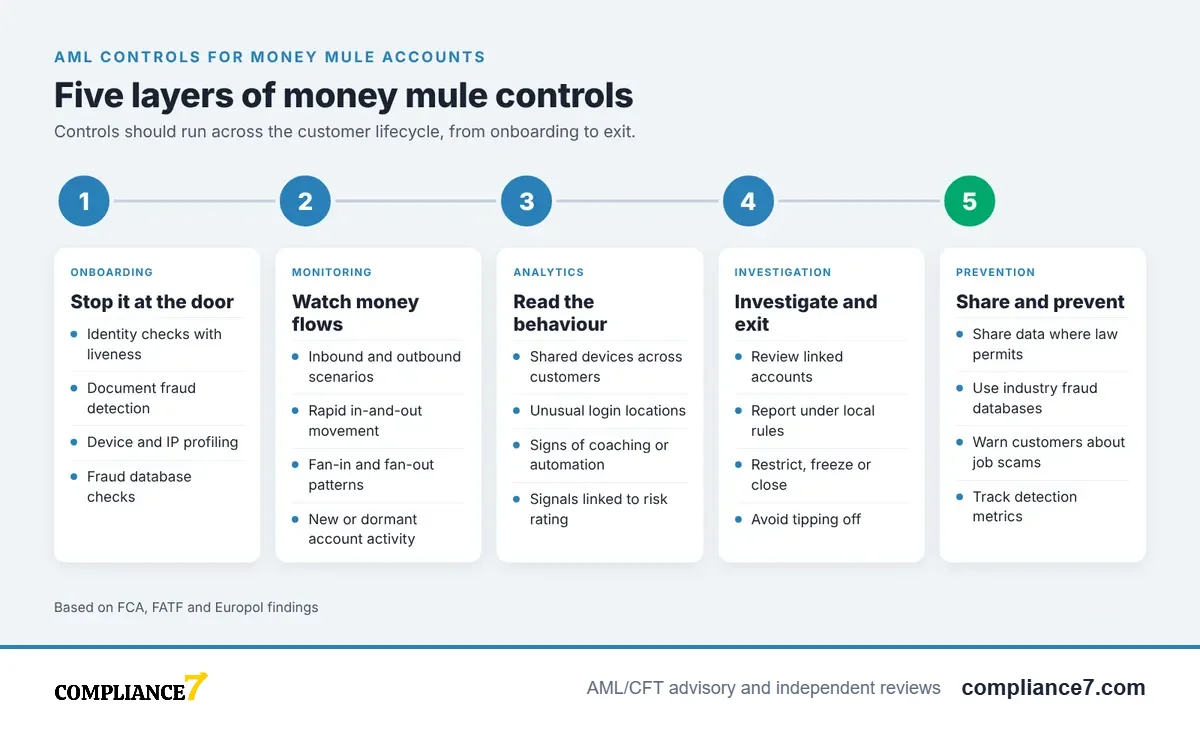
Effective controls for money mule accounts work across the whole customer lifecycle. In practice, most firms need five layers.
1. Onboarding controls to stop money mule accounts
First, strong onboarding stops many mule accounts before they open. Typical controls include identity verification with liveness checks and document fraud detection. They also include device and IP profiling and check against fraud databases where available. In its 2023 review, the FCA noted good practice such as facial recognition, device profiling and geolocation. It also found that some firms carried out relatively few checks at onboarding.
2. Transaction monitoring
Next, monitoring should cover money coming in, not only money going out. The FCA found that some firms focused on outbound monitoring and lacked adequate inbound monitoring. Useful scenarios include rapid movement of funds soon after receipt and many unrelated third-party credits followed by consolidated transfers out. Others cover fan-in and fan-out patterns, sudden changes in volume or counterparties, and transfers to accounts already linked to suspicious activity. Fraud detection and AML monitoring overlap here, but they serve different purposes. So firms should connect them without merging their reporting duties. Our guide to real-time AML monitoring for instant payments covers monitoring at payment speed.
3. Behavioural and device analytics
In addition, behavioural signals can reveal accounts controlled by someone other than the customer. Examples include shared devices across unrelated customers, unusual login locations and session behaviour that suggests automation or coaching. Linking these signals to the customer’s risk rating helps analysts prioritise alerts.
4. Investigation, reporting and exit
When indicators appear, analysts should investigate promptly and look beyond the single account. The FCA has encouraged firms to consider linked accounts within the same institution. Where reasonable grounds for suspicion exist, firms should file a suspicious transaction report (STR), suspicious activity report (SAR) or the local equivalent. They should not wait for proof of the underlying crime.
Next, firms should decide on any account restriction or exit. Internal restrictions under account terms differ from statutory freezes, which usually need a legal power or an order from a competent authority. So, any action should have a clear legal basis and follow local law enforcement liaison procedures. Throughout, firms must avoid tipping off the customer.
5. Information sharing and prevention
Finally, mule chains cross institutions, so no single firm sees the whole picture. Where the law permits, firms can share fraud and mule data with other firms, industry databases and authorities. However, sharing needs a lawful basis and must respect data protection, banking confidentiality and any cross-border transfer rules. Access to industry databases also varies by country and sector. Customer education also helps. For example, warnings about fake job offers can stop people becoming mules in the first place.
Governance and testing of money mule controls
Mule controls need clear ownership between fraud and AML teams, because the activity sits across both. In addition, firms should track metrics such as:
- time from suspicious activity to alert and from alert to investigation;
- alert escalation and conversion rates, including false positives;
- time taken to restrict or exit identified mule accounts;
- repeat use of accounts previously linked to mule activity; and
- timeliness of suspicious transaction reporting.
These metrics matter. After all, the FCA found that criminals had reused some accounts several times before firms shut them down. Firms should also test their rules and analytics regularly against known cases and emerging typologies.
An independent review can test whether these controls work in practice. For example, it can check whether monitoring scenarios fire on known mule patterns and whether investigations look at linked accounts. Our list of common AML audit findings covers related monitoring gaps.
Worked example: investigating suspected money mule accounts
Consider an illustrative case. A newly opened personal account receives 18 transfers from unrelated people over two days. Within minutes of each credit, the customer moves about 90% of the balance to three other accounts. Yet the customer’s profile shows salaried employment and no business activity. An analyst would typically:
- flag the unusual inbound pattern and the speed of outgoing transfers;
- compare the activity with the customer’s expected account use;
- check linked accounts, counterparties and shared devices;
- review fraud reports and earlier alerts on the same parties;
- document the findings and decide whether a reporting obligation arises; and
- escalate any restriction decision under the firm’s policy.
Common gaps in controls for money mule accounts
Firms should check their controls for these common weaknesses:
- Light onboarding checks for low-value or digital-only products.
- Monitoring scenarios that focus on outbound payments only.
- No device or behavioural data feeding into AML monitoring.
- Investigations that review one account in isolation.
- Slow exit decisions, which let criminals reuse accounts.
- Fraud and AML teams working from separate data and case systems.
Frequently asked questions (FAQ)
What is the difference between a money mule account and a fraud victim’s account?
A victim’s account is the source of stolen funds. By contrast, a money mule account receives and moves those funds on. However, some mules are victims too, for example when criminals deceive or coerce them.
Are money mules always aware they are laundering money?
No. Some mules are complicit, but others believe they are doing legitimate work or act under pressure. Even so, firms should assess the activity on the account, whatever the customer’s awareness.
Which firms are most exposed to money mule accounts?
Any firm that opens accounts or moves funds faces this risk. However, digital banks, payment institutions and e-money firms can face higher risk because of fast onboarding. In the UK, for instance, the FCA found that 74.1% of suspected mule accounts offboarded by e-money institutions in 2025 had been open for less than six months.
Should a firm file a suspicious transaction report for every suspected mule account?
Not automatically. An account flagged for potential mule activity should be investigated promptly. Where the assessment gives rise to suspicion, or reasonable grounds to suspect that funds are proceeds of crime or linked to money laundering, the firm should file an STR, SAR or local equivalent in accordance with applicable law. Reporting does not require confirmation of the underlying criminal activity. Firms should also comply with local reporting timelines and confidentiality requirements.
Can a firm freeze a suspected money mule account?
It depends on the applicable law, account terms and any directions from competent authorities. Firms may have contractual or regulatory grounds to restrict some account activity. By contrast, a statutory freeze or attachment usually needs specific legal authority or an order. So, any restriction should have a clear legal basis, set out in policy with legal input.
Related Compliance7 guides
- Core guide: Real-Time AML Monitoring for Instant Payments (2026 Guide)
- Related: Is Your AML Screening Actually Working? What Regulators Found
- Related: Why Customer Risk Scoring Models Fail During AML Audits and How to Fix Them
- Related: STR Filing in India: FIU-IND Reporting Requirements, Process and Penalties
Need support strengthening your AML controls?
Compliance7 Consulting provides independent AML/CFT audits, risk assessments and advisory support to banks, NBFIs and fintechs. We help organisations assess their AML frameworks, identify control weaknesses and strengthen transaction monitoring, customer due diligence and suspicious transaction reporting processes.
Explore our AML/CFT services or contact Compliance7 to discuss your requirements.
This article is for informational purposes only and does not constitute legal or regulatory advice. Requirements vary by jurisdiction. For guidance specific to your business, consult a qualified compliance professional.