
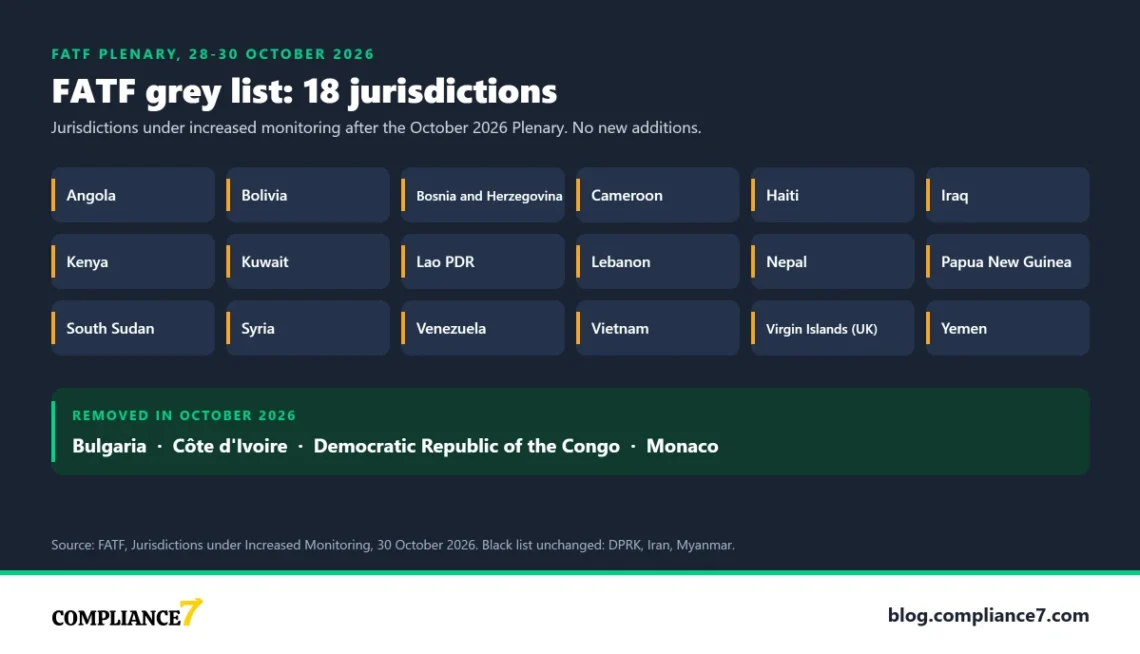
The FATF grey list changed again at the October 2026 Plenary. On 30 October 2026, the Financial Action Task Force (FATF) removed Bulgaria, Côte d’Ivoire, the Democratic Republic of the Congo and Monaco from its list of jurisdictions under increased monitoring. It added no new jurisdictions, so the grey list now has 18 entries. As a result, compliance teams at banks, fintechs, VASPs and DNFBPs should update their country risk ratings. They should also review measures applied to clients linked to the removed jurisdictions.
This page summarises what changed on the FATF grey list, the full current list and the black list. It also covers other Plenary outcomes that matter for AML programmes. We update it after each FATF Plenary, so it also records the June 2026 changes below.
| Area | October 2026 outcome | What to do |
|---|---|---|
| Removed from the grey list | Bulgaria, Côte d’Ivoire, Democratic Republic of the Congo, Monaco | Review country risk ratings and any listing-based measures |
| Added to the grey list | None | No new jurisdictions to escalate |
| Grey list total | 18 jurisdictions (down from 22) | Update screening and risk country lists |
| High-risk jurisdictions subject to a call for action (black list) | DPRK, Iran and Myanmar (unchanged) | Countermeasures for DPRK and Iran; enhanced due diligence proportionate to risk for Myanmar |
| Possible FATF follow-up by February 2027 | Vietnam (grey list) and Myanmar (black list) | FATF may consider next steps on Vietnam and countermeasures on Myanmar |
| Virtual assets | New targeted review, results due June and October 2027 | More scrutiny of VASP regimes |
What changed on the FATF grey list in October 2026
The October 2026 Plenary was the first under the UK Presidency of Giles Thomson. It took place in Paris from 28 to 30 October 2026.
Four jurisdictions removed
Specifically, the FATF removed Bulgaria, Côte d’Ivoire, the Democratic Republic of the Congo and Monaco following successful on-site visits. Each had completed its action plan within the agreed timeframes. They will keep working with their FATF-style regional bodies to sustain the improvements:
- Bulgaria and Monaco: MONEYVAL;
- Côte d’Ivoire: GIABA; and
- Democratic Republic of the Congo: GABAC and ESAAMLG.
Removal does not mean a jurisdiction is low risk. Instead, it means the FATF is satisfied that the jurisdiction has completed its agreed action plan, so it is no longer subject to increased monitoring. Each must still sustain its improvements through its regional body. So firms should review, rather than simply keep, any extra measures they applied because of the listing.
No new jurisdictions added
No jurisdiction joined the FATF grey list in October 2026. As a result, the list fell from 22 to 18 jurisdictions.
Vietnam: significant concern over progress
The FATF expressed significant concern about Vietnam’s pace of progress. It will consider next steps if Vietnam does not make tangible improvements by the next Plenary, expected in February 2027. Because Vietnam’s action plan includes regulating virtual assets and VASPs, crypto businesses with Vietnamese exposure should watch this closely.
Full FATF grey list: 18 jurisdictions as of October 2026
The 18 jurisdictions on the FATF grey list are:
- Angola
- Bolivia
- Bosnia and Herzegovina
- Cameroon
- Haiti
- Iraq
- Kenya
- Kuwait
- Lao PDR
- Lebanon
- Nepal
- Papua New Guinea
- South Sudan
- Syria
- Venezuela
- Vietnam
- Virgin Islands (UK)
- Yemen
Bosnia and Herzegovina, Haiti, Iraq and Yemen chose not to report this cycle. So the FATF repeated their earlier statements, which may not reflect their latest position. Also, always check the FATF’s official statement before updating screening lists, because the FATF may revise its statements between Plenaries.
Does the FATF grey list require enhanced due diligence?
No, not automatically. The FATF states that it does not call for enhanced due diligence to be applied to jurisdictions under increased monitoring. Its Standards do not envisage de-risking or cutting off entire classes of customers. Instead, firms should take the listing into account in their own risk analysis, alongside their actual customers, products and transactions. However, local laws or regulators may still require specific measures, so check your own jurisdiction’s rules.
The FATF black list in October 2026
The list of high-risk jurisdictions subject to a call for action is often called the black list. It still has three entries: the Democratic People’s Republic of Korea (DPRK), Iran and Myanmar.
For the DPRK and Iran, the FATF reiterated its call on all jurisdictions to apply countermeasures, given heightened proliferation financing risks. In addition, the FATF updated its statement on Iran. It repeated its call for Iran to criminalise terrorist financing and set up a targeted financial sanctions regime.
For Myanmar, the FATF continues to call for enhanced due diligence proportionate to the risk. However, it warned that it will consider countermeasures if Myanmar makes no further progress by February 2027. It also noted that fraud and cyber scam activities in Myanmar remain extensive.
Other October 2026 Plenary outcomes for compliance teams
A targeted review of virtual asset implementation
The Plenary agreed to launch a targeted review and accelerated follow-up process for virtual assets and VASPs. Based on objective criteria, the review will focus on jurisdictions with materially important virtual asset sectors, taking into account their assessment status. The FATF will publish the results in June and October 2027. For VASPs, this is likely to increase supervisory attention in key markets and may affect how counterparty jurisdictions are assessed. Our guide to counterparty VASP due diligence covers how jurisdiction risk feeds into that assessment.
A new report on scam compounds
Next, the Plenary approved a report on the illicit financial flows linked to scam compounds, which the FATF published in November 2026. It is the first output of the FATF’s fraud roadmap under the UK Presidency. Our breakdown of the scam compound report covers its findings.
Mutual evaluations of Mexico and the United States
The Plenary also adopted the mutual evaluation reports of Mexico and the United States. The FATF expects to publish them in December 2026, after a quality and consistency review.
Risk-based approach and low-capacity countries
The FATF will introduce tailored assessments for some low-capacity countries. It will also host a Learning and Development Forum on the risk-based approach in Dallas on 1 and 2 December 2026. A policy statement will follow. Finally, the suspension of the Russian Federation’s FATF membership continues.
What changed in June 2026
For reference, the June 2026 Plenary added Iraq and Bosnia and Herzegovina to the FATF grey list. At the same time, it removed Algeria and Namibia. Iraq’s action plan covers risk understanding, detection of informal money or value transfer services, a legal framework for VASPs, targeted financial sanctions, STR quality and beneficial ownership, among other areas. Bosnia and Herzegovina’s action plan focuses on risk understanding, international cooperation, DNFBP supervision, beneficial ownership information, money laundering prosecutions and terrorist financing cases.
The June Plenary also updated Recommendation 6 to include humanitarian exemptions from UN Security Council Resolutions 2664 and 2761. In addition, it approved a public consultation on guidance for the strengthened payment transparency standard in Recommendation 16.
Practical steps after the October 2026 FATF grey list update
First, update your country risk ratings. Review the ratings for Bulgaria, Côte d’Ivoire, the Democratic Republic of the Congo and Monaco. However, a grey list exit is only one input. So consider other factors, such as sanctions, corruption and your own exposure, instead of downgrading automatically.
Next, review clients and counterparties linked to the removed jurisdictions. Where you applied extra measures only because of the listing, check whether they are still proportionate. However, also check separate statutory lists, such as the EU’s list of high-risk third countries or local regulator lists. These may update on a different timetable from the FATF grey list.
Then, check your screening and monitoring rules. Make sure country lists in onboarding, transaction monitoring and payment screening reflect the current FATF grey list and black list. Also confirm that your systems update from a controlled source.
In addition, watch Vietnam and Myanmar. The FATF will consider next steps on Vietnam and countermeasures on Myanmar if progress falls short by the February 2027 Plenary. Firms with exposure to either should prepare for a possible change in expectations.
Finally, brief front-line staff. A short internal alert helps onboarding and monitoring teams apply the changes consistently.
Key takeaways from the October 2026 FATF grey list update
The October 2026 FATF grey list update produced a shorter list, with four exits and no additions. Even so, the Plenary signalled more pressure on virtual asset regimes, fraud and scam compounds. So compliance teams should update their country risk ratings now. They should also watch the February 2027 Plenary for decisions on Vietnam and Myanmar.
If your firm needs support updating risk assessments or recalibrating screening, Compliance7 can help. Book a free consultation to discuss how these changes affect your business.
Frequently asked questions
How many countries are on the FATF grey list?
After the October 2026 Plenary, 18 jurisdictions are on the FATF grey list. The FATF removed four jurisdictions and added none.
What is the difference between the FATF grey list and black list?
The grey list covers jurisdictions under increased monitoring that are working through an agreed action plan. By contrast, the black list covers high-risk jurisdictions subject to a call for action, where the FATF calls for enhanced due diligence or countermeasures.
When is the next FATF grey list update?
The FATF updates its lists after each Plenary. The next Plenary is expected in February 2027.
Related Compliance7 guides
- Related: Scam Compound Money Laundering: FATF’s 2026 Report Breakdown
- Related: Counterparty VASP Due Diligence: Assessing the VASP on the Other Side of a Transfer
- Related: Post-Grey-List Africa: Why Independent AML Audits Matter More, Not Less, After Exit
- More: All Global AML Regulatory Updates
This article is for informational purposes only and does not constitute legal or regulatory advice. For guidance specific to your business, consult a qualified compliance professional.




One comment on “FATF Grey List Update – October 2026: What Compliance Teams Must Know”
Comments are closed.