
Global fraud costs an estimated USD 500 billion each year, according to figures cited by the Financial Action Task Force (FATF). Scam compounds represent a significant and growing part of this threat, generating tens of billions of dollars in estimated annual losses through organised, cross-border criminal operations that combine recruitment, technology, telecommunications and money laundering. On 5 November 2026, the FATF published Combating End-to-End Illicit Financial Flows Linked to Scam Compounds, a landmark report examining how scam compound money laundering works and what governments and financial institutions can do to disrupt it. The report draws on input from 60 jurisdictions and includes nearly 120 case studies.
For banks, fintechs, payment providers, money services businesses and virtual asset service providers (VASPs), the report raises a direct question: can your AML controls identify the wider financial networks behind scam-related transactions? This article breaks down the key findings and outlines practical steps compliance teams should take now.
The FATF report provides policy principles and operational guidance rather than introducing new standalone AML/CFT obligations. Financial institutions should assess its recommendations alongside applicable national AML/CFT legislation, regulatory requirements and existing supervisory expectations.
| Compliance area | Key finding | Why it matters |
|---|---|---|
| Money mule networks | Criminal networks recruit account holders to receive and move victim funds across institutions | Customer-level monitoring alone may miss coordinated mule activity |
| Instant payments | Scam proceeds can move through payment systems in as little as two minutes | Post-transaction alerts may arrive too late for effective intervention |
| Virtual assets | Some scam compounds operate dedicated OTC crypto exchange desks on-site | VASPs need blockchain analytics and counterparty due diligence to detect exposure |
| Fraud and AML coordination | Victim-authorised payments look legitimate in transaction data | Fraud intelligence must feed into AML monitoring and investigation |
| Cross-border cooperation | Victims, mules and criminal operators typically sit in different countries | Information-sharing arrangements and rapid escalation are essential |
What are scam compounds and how do they operate?
Scam compounds are organised environments where criminal networks conduct online fraud at scale. They range from large physical facilities to smaller decentralised setups and mobile operations. Some workers participate knowingly. Others are deceived through fraudulent job offers and may not initially understand their role in the criminal operation. In more severe cases, individuals are subjected to trafficking, coercion or forced criminal activity. The FATF estimates that 120,000 people are forced to run online scams in Myanmar alone.
These operations function through interconnected groups: recruitment networks, technology providers, social media operators, money mules, payment intermediaries, virtual asset brokers and corporate structures used to conceal ownership. As a result, a financial institution may encounter just one account or transaction linked to a much broader criminal operation.
The FATF maps seven stages in the scam compound financial flow, from setting up infrastructure through to profit reinvestment. In practice, these stages overlap rather than following a strict sequence. Criminal networks fund their operations, extract victim payments, layer and convert proceeds and reinvest profits simultaneously. Because of this, AML monitoring that focuses only on the initial receipt of funds will miss activity at other stages of the cycle. Institutions should also consider subsequent transfers, conversion activity and relationships between apparently unrelated customers.
Financial channels that scam compounds exploit
The FATF identifies several financial channels exploited by scam compound networks. Three particularly relevant channels for financial institutions and compliance teams are outlined below.
Bank accounts and money mules remain the most common channel. Mule accounts receive victim payments and pass funds onward through multiple transfers. Red flags include accounts receiving payments from numerous unrelated individuals, rapid outbound transfers following deposits, activity inconsistent with the customer’s profile and newly opened accounts with unusually high volumes. For a deeper look at mule typologies, see Compliance7’s guide to Money Mule Accounts: Red Flags and AML Controls.
Instant payment systems allow scam proceeds to move within minutes, often before monitoring systems generate an alert. Moreover, the challenge grows when victims authorise payments themselves after being manipulated by scammers. These transactions look legitimate in transaction data because the customer authenticated the transfer. Detecting the underlying fraud therefore requires additional context: beneficiary risk indicators, device intelligence and telecommunications signals. Financial institutions should assess whether their monitoring arrangements can identify relevant patterns quickly enough to support timely intervention.
Virtual assets and over-the-counter (OTC) services provide another conversion and transfer channel. The FATF found cases of scam compounds running their own OTC exchange desks. VASPs should watch for deposits from multiple unrelated wallets, rapid conversion after incoming transfers and interactions with wallets linked to known illicit activity. Blockchain analytics can help trace exposure, but findings should be assessed alongside attribution confidence, transaction pathways and customer explanations. Compliance7’s guide to Counterparty VASP Due Diligence covers the assessment framework in detail.
Why conventional AML monitoring falls short
Traditional transaction monitoring arrangements often place significant emphasis on customer- or account-level analysis. While these approaches can identify unusual individual transactions and customer behaviour, they may not adequately reveal coordinated activity involving multiple apparently unrelated customers, accounts and counterparties. Scam compound networks expose the limitations of relying predominantly on isolated customer or account-level assessments.
First, visibility is fragmented. Multiple financial institutions may each see only one part of the same financial flow. One bank may identify the initial victim payment, while another sees the subsequent transfer or conversion into virtual assets. Second, victim-authorised payments can be harder to detect because the customer has authenticated the transaction. Conventional fraud controls that rely heavily on transaction authentication may therefore fail to identify the underlying manipulation or deception. Third, apparently unrelated account holders may collectively support the same criminal network, but their connections may remain undetected through customer-by-customer review. Finally, criminal networks are adapting. AI-generated content, deepfakes and decentralised operating models make scam operations harder to detect using static geographic indicators or fixed assumptions.
Addressing these gaps requires network analysis that connects accounts, beneficiaries, devices and wallets across customers. It also requires closer coordination between fraud, AML, cyber security and payment operations teams. Fraud monitoring and AML monitoring serve different but complementary purposes in identifying and disrupting scam-related financial flows. Fraud teams may identify a victim payment in progress, while AML teams may detect a receiving account involved in a wider pattern of suspicious transactions. Institutions that operate these functions in isolation risk missing the connections that reveal the broader criminal network.
Practical controls to strengthen against scam compound money laundering
The FATF report gives compliance teams a useful framework for reviewing their AML programs. The following areas deserve priority attention.
Risk assessment. Evaluate whether your institutional risk assessment covers scam compound-related risks across customer segments, products, payment channels, geographic corridors and virtual asset exposure. Consider how your products could be misused at different stages of the financial flow, not only at the point of initial collection.
Transaction monitoring. Review whether existing scenarios capture patterns associated with scam proceeds: rapid fund movement from multiple unrelated senders, transfers to common beneficiaries, unusual activity from newly onboarded customers and rapid conversion to virtual assets. Calibrate rules against your customer base and test them regularly.
Network and link analysis. Move beyond customer-by-customer review. Several unrelated accounts may receive payments from different victims but transfer funds to the same small group of beneficiaries. Viewed individually, each looks unremarkable. Viewed collectively, they reveal a coordinated mule network. The sophistication of tools should be proportionate to your institution’s size and risk profile.
Escalation and rapid response. The FATF highlights the first 24 to 72 hours after a scam is detected as a critical intervention window for initiating fund freezes, payment recalls and recovery efforts. Review whether your procedures support timely escalation between fraud, AML and payment operations teams. This includes payment recall mechanisms and temporary holds where authorised under applicable law and contractual arrangements. Prompt communication with receiving institutions is equally important.
Staff training. Front-line, monitoring and investigations staff should recognise scam-related financial flow patterns and potential indicators of coercion or trafficking among account holders. Training should cover the end-to-end lifecycle described in the FATF report, not only the indicators relevant to a single team’s function.
Testing. Periodically test whether controls are designed appropriately and operating effectively in practice. Review the coverage of monitoring scenarios, assess escalation timelines and check the quality of suspicious activity investigations. Document gaps, assign remediation owners and track completion. For more on testing AML frameworks, see Compliance7’s AML Independent Audit guide.
Disruption, information sharing and a victim-centred approach
The FATF emphasises that effective disruption works in two directions. Downstream action targets victim payments, mule networks and illicit proceeds after a scam has occurred. Upstream action targets the criminal infrastructure before victims pay: fraudulent recruitment, malicious domains, telecoms infrastructure and enabling service providers.
Real-world examples show what coordinated action looks like. Indonesia’s Anti-Scam Centre blocked 702,833 accounts and returned approximately USD 11.55 million to victims between November 2024 and September 2026. The UK’s Scam Signals service, which delivers real-time mobile-network risk indicators to banks during payment authorisation, has been associated with a 41% reduction in people scammed and a 44% decrease in fraud losses.
Because scam compounds create victims on both sides of the operation, institutions should avoid assuming that every account holder involved in suspicious activity is a willing participant. Some may be trafficking victims acting under coercion. Where credible indicators of exploitation exist, institutions should follow appropriate escalation and referral procedures rather than treating these individuals primarily as offenders.
Information sharing between financial institutions, VASPs, telecoms providers and public authorities can reveal common beneficiaries, mule accounts and suspicious infrastructure. All sharing must operate within applicable legal frameworks, including data protection, banking secrecy and tipping-off restrictions.
Conclusion
Scam compound money laundering exploits the connections between financial services, technology, telecommunications and cross-border payments. The FATF’s November 2026 report reinforces the need to look beyond isolated suspicious transactions and examine the wider networks that generate, move and conceal criminal proceeds.
For compliance teams, the practical takeaway is clear. Strengthen risk assessments, transaction monitoring and network analysis. Break down the walls between fraud, AML and cyber security functions. Build escalation procedures that can act within the critical first hours after a scam is detected. Participate in lawful information-sharing arrangements that extend your visibility beyond your own customer base.
The institutions best positioned to disrupt scam compound money laundering are those that combine customer-level monitoring with network-based intelligence and rapid, coordinated intervention. The question for every compliance team is not simply whether your institution can flag suspicious transactions, but whether it can recognise the relationships connecting those transactions to a wider criminal network.
Frequently asked questions (FAQ)
What is scam compound money laundering?
Scam compound money laundering refers to the collection, movement, concealment and conversion of proceeds generated by organised online scam operations. Criminal networks use bank accounts, money mules, payment services, informal transfer channels and virtual assets to move these funds across jurisdictions.
How are virtual assets used in scam compound money laundering?
Virtual assets allow criminal networks to transfer, convert and move scam proceeds across wallets and borders. Some compounds operate their own OTC exchange desks. Blockchain analytics can trace relevant transactions and flag exposure to known illicit wallet clusters, but those findings require careful contextual assessment.
What does the FATF recommend to combat scam compounds?
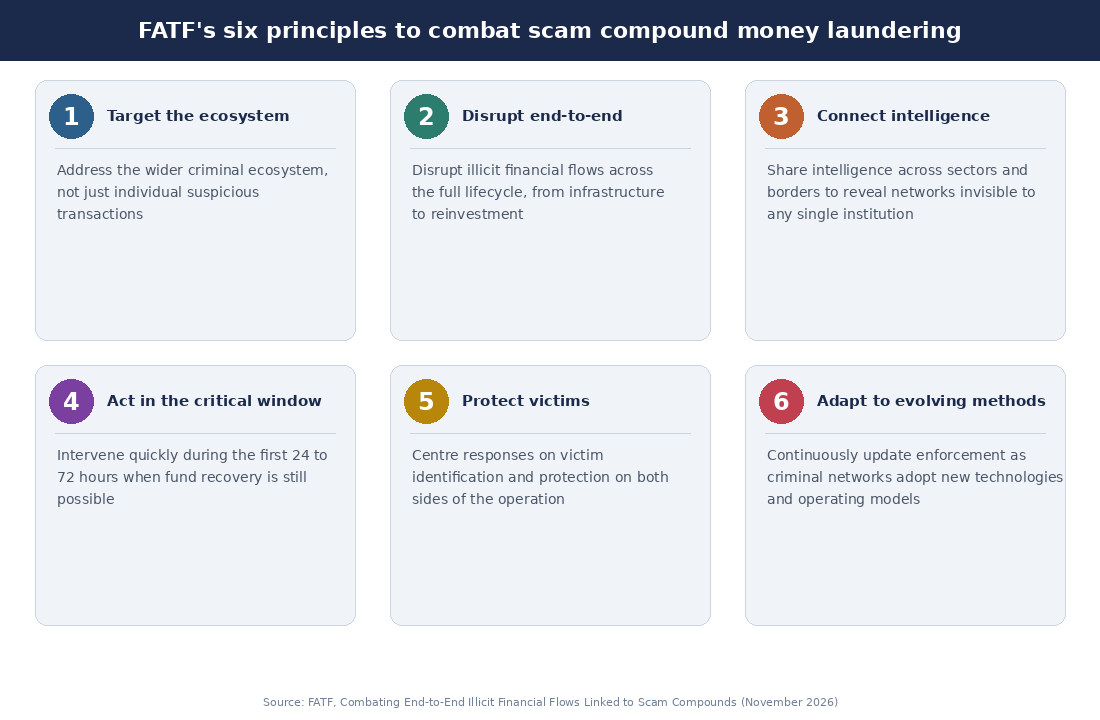
The FATF’s 2026 report sets out six principles: target the wider criminal ecosystem rather than individual transactions, disrupt illicit financial flows end-to-end, connect intelligence across sectors and borders, act quickly during the critical intervention window, centre responses on victim protection and adapt enforcement as criminal methods evolve.
This article is for informational purposes only and does not constitute legal or regulatory advice. For guidance specific to your business, consult a qualified compliance professional.